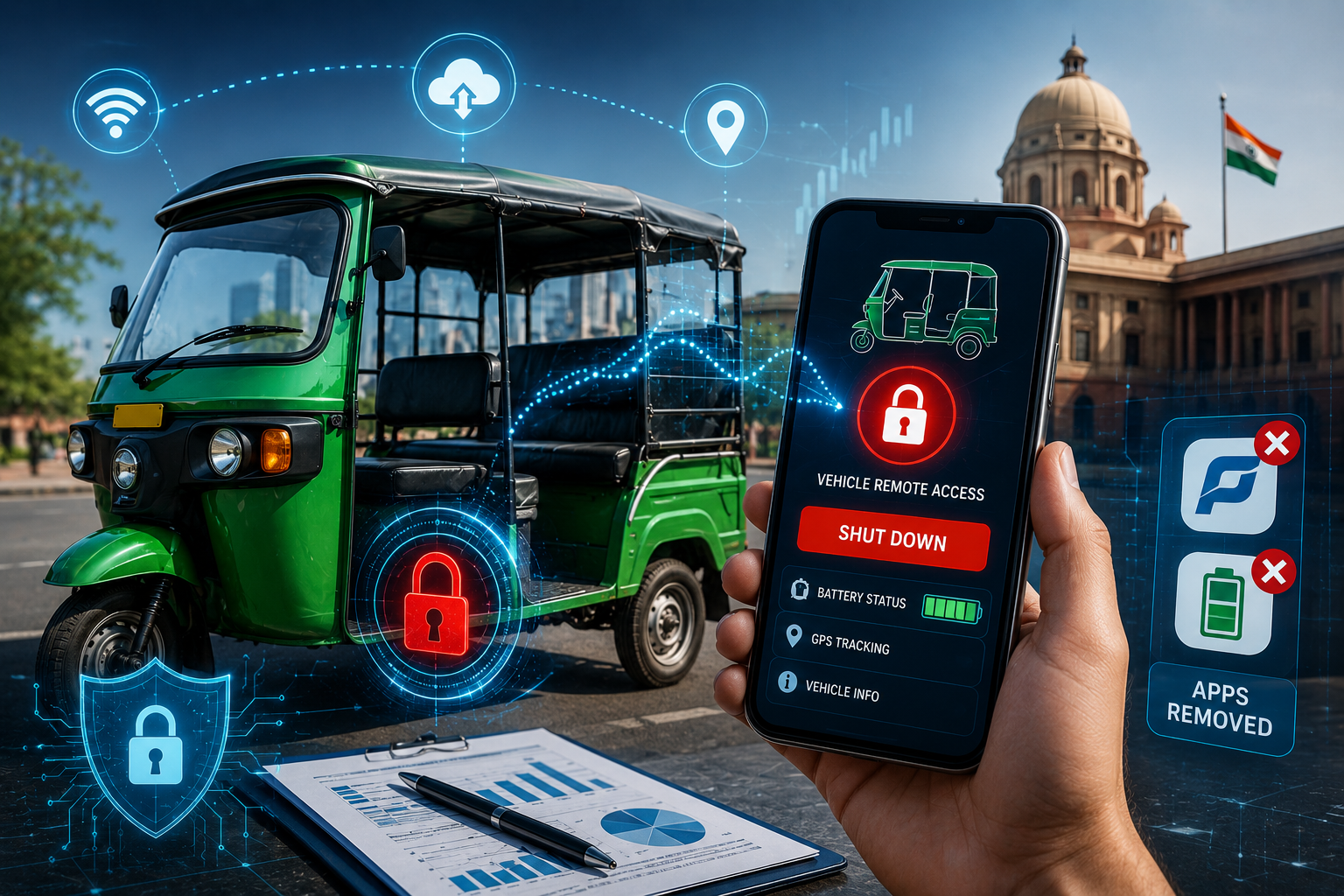
Two Mobile Applications Removed from App Stores as Centre Reviews Cybersecurity Risks in India's Expanding Electric Vehicle Ecosystem
The Central Government has stepped up its scrutiny of connected vehicle applications after reports emerged that certain electric rickshaws could allegedly be remotely disabled through a smartphone application. In response, authorities have confirmed that two mobile applications linked to the issue have been removed from app stores, marking one of the first significant regulatory actions involving software used in India's rapidly growing electric mobility sector.
The development highlights the increasing importance of cybersecurity in connected vehicles as software becomes an integral part of transportation infrastructure. Industry experts believe the incident could lead to stricter digital compliance standards for electric vehicle manufacturers, battery management system providers, and app developers.
Government Acts Swiftly After Security Concerns Surface
Speaking at a cybersecurity event, IT Secretary S. Krishnan confirmed that the government had identified two applications associated with the issue and ensured their removal from app marketplaces.
He also emphasized that app store operators have a responsibility to exercise greater due diligence before hosting applications that interact with critical systems such as connected vehicles.
According to officials, the government will continue engaging with digital platform operators to strengthen monitoring mechanisms and prevent potentially harmful applications from becoming publicly available.
The swift action demonstrates the government's increasing focus on digital safety as India's economy becomes more technology-driven.
How the Issue Came to Light
The controversy began after videos circulating on social media allegedly showed electric rickshaws being remotely disabled through a smartphone application reportedly connected to the vehicle's Battery Management System (BMS).
The reports quickly raised concerns regarding the possibility of unauthorized access to connected vehicles and the broader cybersecurity implications for India's fast-growing electric mobility ecosystem.
Although authorities have not indicated that the issue was widespread, the possibility that software could remotely influence vehicle operations prompted immediate regulatory attention.
The incident has also reignited discussions around digital sovereignty and cybersecurity in connected transportation systems.
Rise of Connected Vehicles Brings New Challenges
Modern electric vehicles are increasingly becoming software-driven products.
Today's EV ecosystem integrates several digital technologies, including:
-
Battery Management Systems (BMS)
-
Mobile applications
-
GPS-based fleet tracking
-
Cloud computing
-
Internet of Things (IoT) connectivity
-
Remote diagnostics
-
Over-the-air software updates
These innovations improve operational efficiency, battery performance, maintenance scheduling, and user experience.
However, every connected feature also expands the potential cybersecurity attack surface, making robust digital protection an essential component of vehicle safety.
Battery Management Systems Are the Digital Heart of EVs
The Battery Management System plays a crucial role in every electric vehicle.
It continuously monitors and controls:
-
Battery temperature
-
Voltage
-
Charging cycles
-
Power distribution
-
Battery health
-
Safety limits
Many manufacturers now allow vehicle owners and fleet operators to monitor these functions remotely using smartphone applications.
While this improves convenience and operational efficiency, cybersecurity experts stress that communication between the vehicle and mobile application must be protected through strong encryption, authentication protocols, and regular software security updates.
Cybersecurity Becomes Critical for India's EV Industry
India's electric mobility market has witnessed rapid growth over the past few years, supported by government incentives, rising fuel prices, and increasing environmental awareness.
As vehicles become increasingly connected, cybersecurity is emerging as a key pillar of the industry's future.
Experts believe manufacturers must invest more heavily in:
Secure Software Development
Building applications with security embedded from the design stage.
Data Encryption
Protecting communication between vehicles, cloud servers, and mobile devices.
Multi-Factor Authentication
Preventing unauthorized access to vehicle management systems.
Continuous Software Monitoring
Identifying vulnerabilities before they can be exploited.
Regular Firmware Updates
Ensuring security patches are deployed promptly across connected vehicles.
Strong cybersecurity practices are expected to become an important differentiator for EV manufacturers over the coming years.
App Stores May Face Higher Compliance Requirements
The latest development also places greater responsibility on app distribution platforms.
Government officials have indicated that app stores should strengthen their review processes for applications capable of interacting with critical infrastructure.
Future regulatory measures could include:
-
Enhanced application verification
-
Mandatory cybersecurity assessments
-
Developer identity verification
-
Periodic software audits
-
Faster removal of high-risk applications
-
Greater cooperation with government agencies
Such measures could significantly improve consumer confidence in connected digital services.
Potential Regulatory Changes Ahead
Industry observers believe the incident may accelerate the development of comprehensive cybersecurity regulations for connected vehicles.
Possible policy initiatives include:
-
Mandatory cybersecurity certification for automotive software
-
Security testing before commercial deployment
-
Standardized communication protocols
-
Stronger data privacy regulations
-
Secure software supply chain requirements
-
Incident reporting obligations
These measures would align India's electric vehicle ecosystem with international best practices.
Opportunities for Technology Companies
The growing emphasis on cybersecurity is expected to create significant opportunities across the technology sector.
Companies operating in:
-
Automotive cybersecurity
-
Artificial Intelligence
-
Embedded software
-
Battery Management Systems
-
Cloud security
-
Internet of Things (IoT)
-
Fleet management platforms
could benefit from rising investments as manufacturers upgrade their digital infrastructure.
Global automotive cybersecurity spending is expected to increase steadily over the next decade as software becomes central to vehicle functionality.
What This Means for India's EV Ecosystem
The incident serves as an important reminder that the future of electric mobility extends beyond batteries and charging infrastructure.
Software reliability, cybersecurity, data protection, and digital trust will increasingly determine consumer confidence and regulatory acceptance.
Manufacturers that proactively invest in secure digital platforms are likely to strengthen both domestic market positioning and export competitiveness as global regulations become more stringent.