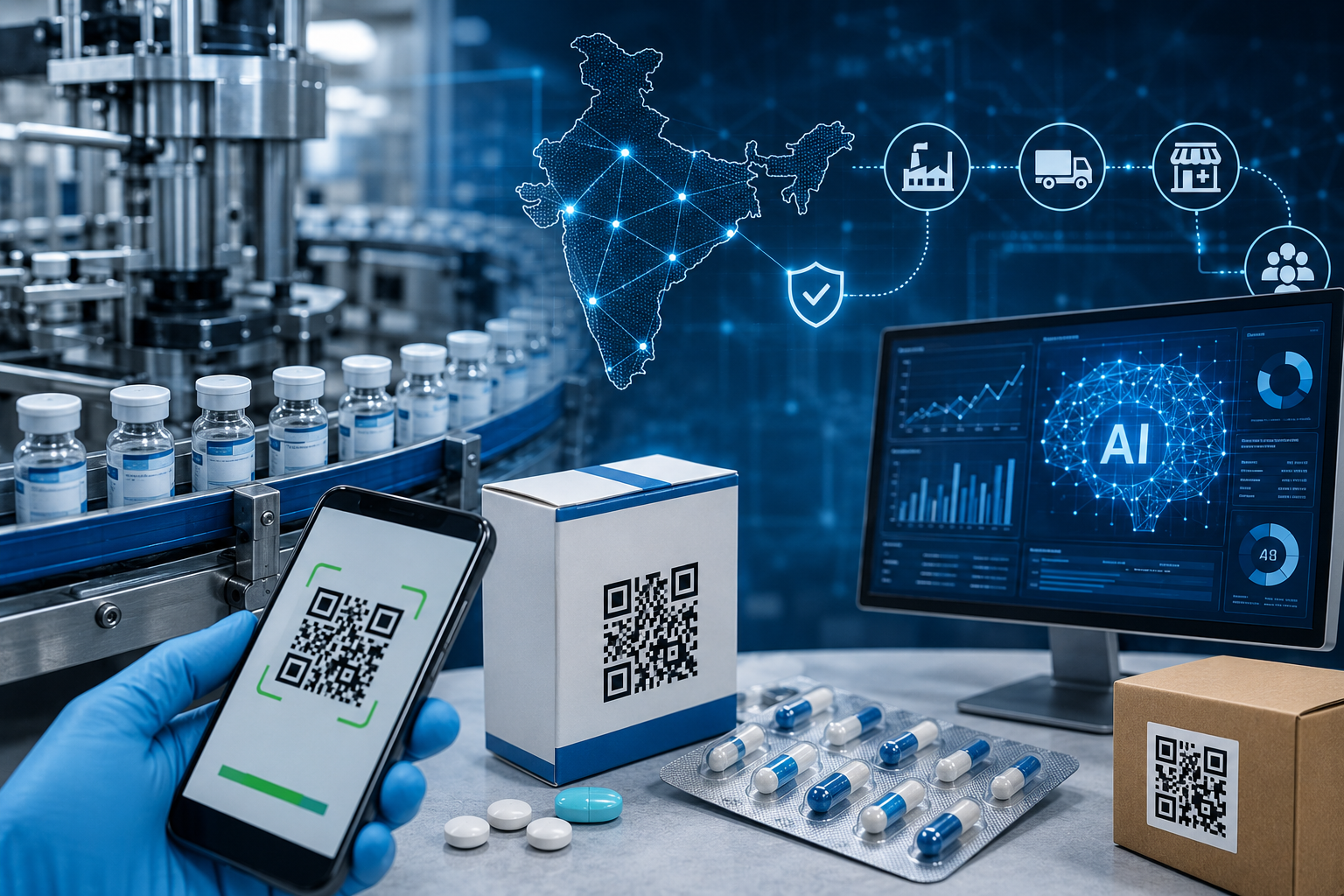
Government Strengthens Drug Traceability While Industry Turns to Artificial Intelligence to Improve Manufacturing Quality and Reduce Defective Medicines
India's pharmaceutical industry is entering a new era of digital transformation as the government expands the mandatory use of QR code-based tracking across a wider range of life-saving medicines. The move is designed to strengthen the fight against counterfeit drugs and improve transparency across the pharmaceutical supply chain. At the same time, industry leaders are advocating for greater adoption of Artificial Intelligence (AI) to improve manufacturing quality, reduce production defects, and enhance regulatory compliance.
Together, these technologies are expected to create a more secure, efficient, and globally competitive pharmaceutical ecosystem. While QR codes help verify the authenticity of medicines after production, AI has the potential to improve quality during manufacturing itself, reducing the chances of substandard medicines reaching patients.
Government Expands QR Code Mandate for High-Risk Medicines
The Ministry of Health has broadened its track-and-trace regulations by extending QR code requirements beyond the country's top-selling pharmaceutical brands.
The expanded framework now covers several critical categories, including:
-
Vaccines
-
Anti-cancer medicines
-
Antimicrobial drugs
-
Narcotic medicines
-
Psychotropic medicines
Every medicine pack will carry a unique digital identity containing information such as product code, batch number, manufacturing date, expiry date, and manufacturer details. This enables every participant in the supply chain—from manufacturers and distributors to pharmacies, hospitals, regulators, and patients—to verify a medicine's authenticity using a simple scan.
The initiative represents another important step toward creating a transparent and digitally connected pharmaceutical supply chain.
India Intensifies Drug Quality Monitoring
The expansion of QR-based tracking comes alongside a significant strengthening of India's pharmaceutical regulatory framework.
Over the past few years, regulators have substantially increased the number of drug samples tested across the country.
The enhanced surveillance has produced encouraging results:
-
Counterfeit medicine detections have declined.
-
Regulatory inspections have increased.
-
Enforcement actions against violations have risen significantly.
-
Product quality monitoring has become more comprehensive.
The government's continued focus on quality assurance reflects India's ambition to strengthen patient safety while maintaining its position as one of the world's leading pharmaceutical manufacturing hubs.
QR Codes Offer More Than Anti-Counterfeit Protection
Although QR codes are primarily introduced to combat fake medicines, their benefits extend much further.
A digital traceability system enables real-time visibility throughout the product lifecycle.
Key advantages include:
Stronger Product Authentication
Patients and healthcare providers can instantly verify whether a medicine is genuine.
Faster Product Recalls
Manufacturers can identify affected batches quickly and remove them from the market more efficiently.
Better Supply Chain Management
Real-time tracking improves inventory control and reduces product diversion.
Improved Regulatory Compliance
Digital records simplify inspections and reporting requirements.
Higher Export Competitiveness
International buyers increasingly expect globally standardized traceability systems.
The adoption of internationally accepted digital standards also strengthens India's reputation in global pharmaceutical exports.
AI Could Revolutionize Pharmaceutical Manufacturing
While QR codes improve visibility after production, Artificial Intelligence addresses an equally important challenge—ensuring medicines are manufactured correctly from the beginning.
Traditional pharmaceutical quality control depends largely on laboratory testing after an entire production batch has been completed.
This reactive approach often results in:
-
Higher manufacturing losses
-
Batch rejection
-
Delayed deliveries
-
Increased production costs
-
Product recalls
AI introduces a predictive approach by continuously monitoring production parameters in real time.
Predictive Manufacturing Reduces Quality Failures
Modern AI systems analyze thousands of production data points simultaneously, helping manufacturers detect abnormalities long before they become quality failures.
These systems monitor factors such as:
-
Temperature stability
-
Humidity levels
-
Mixing consistency
-
Equipment performance
-
Environmental conditions
-
Chemical composition
-
Production timing
If unusual patterns emerge, AI algorithms can immediately alert operators, allowing corrective action before a batch falls outside regulatory specifications.
This significantly reduces waste while improving manufacturing consistency.
From End-Product Testing to Real-Time Quality Assurance
Industry experts believe pharmaceutical manufacturing is shifting from traditional quality inspection toward continuous quality monitoring.
Rather than relying solely on laboratory testing after production, companies are increasingly integrating AI into every stage of manufacturing.
Potential applications include:
Process Validation
Ensuring every manufacturing stage consistently meets quality standards.
Environmental Monitoring
Tracking clean-room conditions continuously to reduce contamination risks.
Predictive Equipment Maintenance
Detecting mechanical issues before they disrupt production.
Root Cause Analysis
Using AI to identify the exact cause of manufacturing deviations.
Regulatory Documentation
Automating quality reports and compliance records.
This transition improves both operational efficiency and regulatory confidence.
Digital Technologies Could Boost India's Global Competitiveness
India is one of the world's largest suppliers of generic medicines and pharmaceutical exports.
As international markets demand higher levels of product traceability and manufacturing transparency, digital technologies are becoming strategic business advantages rather than optional investments.
Companies embracing AI, automation, cloud computing, and digital traceability may benefit from:
-
Faster regulatory approvals
-
Improved operational efficiency
-
Lower manufacturing costs
-
Reduced product recalls
-
Greater customer confidence
-
Stronger export opportunities
Digital transformation is therefore expected to become a major competitive differentiator for Indian pharmaceutical manufacturers over the coming decade.
Challenges to Large-Scale Implementation
Despite the clear benefits, adopting AI and digital traceability technologies remains challenging for many pharmaceutical companies, particularly small and mid-sized manufacturers.
Some of the key hurdles include:
-
High implementation costs
-
Limited digital infrastructure
-
Data integration challenges
-
Cybersecurity concerns
-
Employee training requirements
-
Compliance with evolving regulations
Industry associations have urged policymakers to provide technical support and incentives to accelerate digital adoption across the sector.
Future Pharma Factories Will Be Smart and Connected
Experts believe the pharmaceutical manufacturing plants of the future will integrate multiple digital technologies into a unified production ecosystem.
Future smart factories could combine:
-
AI-powered manufacturing analytics
-
QR-based medicine tracking
-
Automated visual quality inspection
-
Internet of Things (IoT) sensors
-
Cloud-based manufacturing systems
-
Digital compliance platforms
-
Predictive maintenance technologies
Such integrated manufacturing environments are expected to improve productivity while significantly reducing quality failures.
Investment Opportunities Emerging in Pharma Technology
The digital transformation of India's pharmaceutical industry is also creating new investment opportunities.
Companies involved in:
-
Artificial Intelligence software
-
Industrial automation
-
Healthcare technology
-
Barcode and QR solutions
-
Digital compliance platforms
-
Cloud infrastructure
-
Industrial IoT
could experience sustained demand as pharmaceutical companies continue modernizing manufacturing operations.
This trend may also benefit technology providers serving life sciences, healthcare analytics, and enterprise software markets.