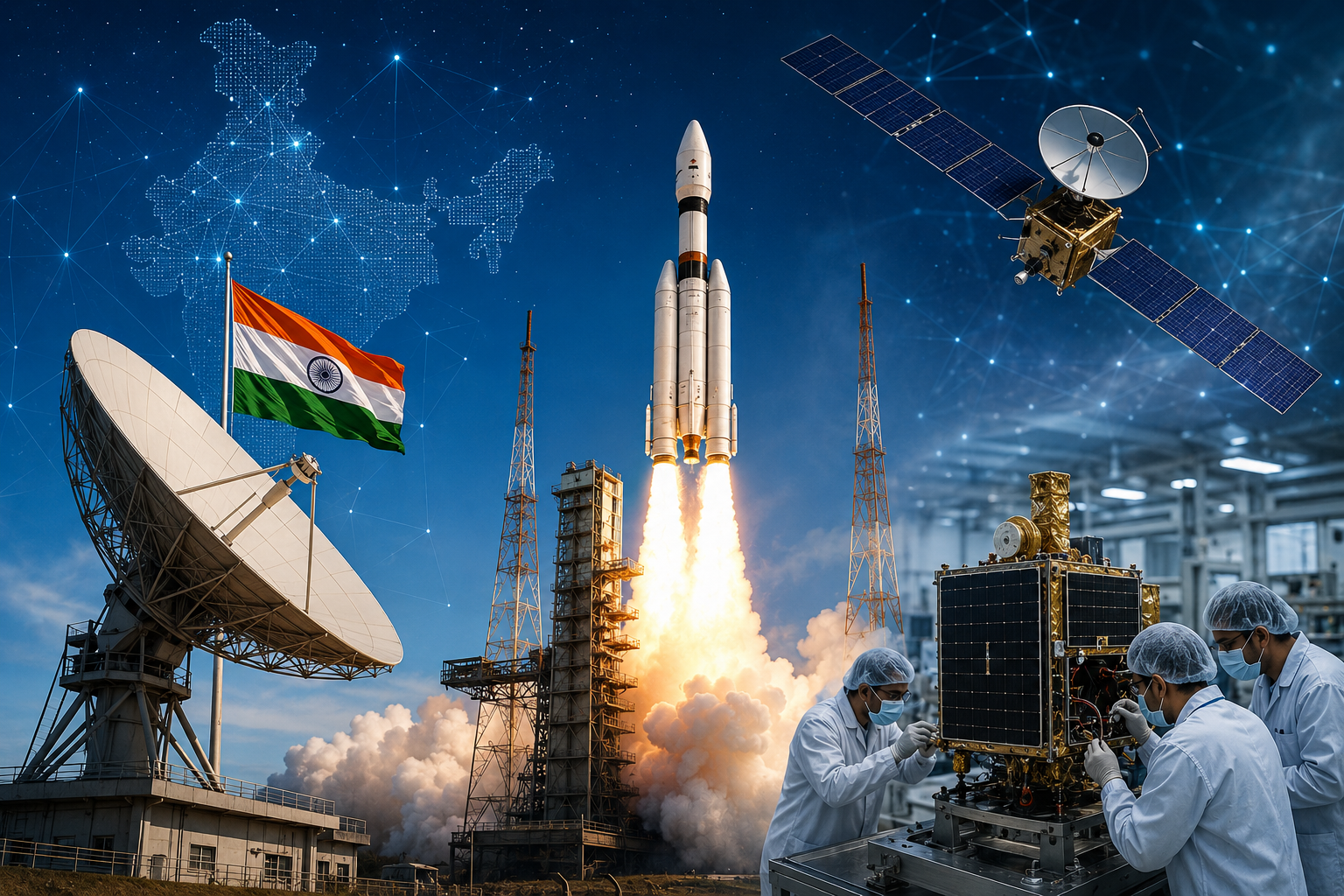
Government Reforms, Rising Investments and Indigenous Technology Are Transforming India into a Global SpaceTech Contender
India's commercial space sector is rapidly emerging as one of the country's most promising high-technology industries, with private startups expanding their capabilities in satellite manufacturing, launch vehicles, Earth observation, communications and defence technologies. Three years after the government opened the space sector to private participation, the ecosystem has evolved from a handful of startups into a vibrant industry attracting global investors, strategic partnerships and growing commercial demand.
The reforms initiated by the Government of India have enabled private companies to design satellites, develop launch vehicles, establish launch infrastructure and commercialize space-based services—areas that were once almost entirely dominated by the Indian Space Research Organisation (ISRO). Today, India's private space companies are serving customers across agriculture, defence, telecommunications, climate monitoring, mining, logistics and disaster management while preparing to compete in the rapidly expanding global space economy.
Industry experts believe that India's combination of engineering talent, cost-efficient manufacturing and supportive government policies could position the country among the world's leading space technology hubs over the next decade.
A New Era for India's Space Economy
India's space programme has traditionally been driven by ISRO, which has earned global recognition for executing complex missions at relatively low costs. From the successful Chandrayaan and Mars Orbiter missions to record-breaking satellite launches, ISRO has demonstrated India's scientific capabilities on the global stage.
Recognising the commercial potential of the sector, the government announced sweeping reforms in 2020 and formally introduced a new space policy in 2023, allowing private companies to actively participate in space activities. The establishment of the Indian National Space Promotion and Authorization Centre (IN-SPACe) has further strengthened the ecosystem by acting as a single-window regulator for private participation.
Private firms now have access to ISRO's testing facilities, launch infrastructure and technical expertise, significantly reducing development costs and accelerating innovation.
Startup Ecosystem Witnesses Rapid Expansion
India's SpaceTech ecosystem has witnessed remarkable growth over the past three years.
According to startup research platform Tracxn, the country currently has around 260 funded space startups, which have collectively raised nearly $730 million in funding. Nearly one-fourth of this capital was invested during the past year alone, reflecting growing confidence among domestic and international investors.
Overall, close to 400 startups are now registered with IN-SPACe, working across satellite manufacturing, propulsion systems, launch vehicles, geospatial analytics, satellite communications, artificial intelligence, space robotics and orbital services.
Many of these startups have begun generating revenues from overseas markets, with exports accounting for nearly one-third of the industry's income.
ISRO Transfers Technology to Strengthen Private Industry
One of the biggest catalysts behind the sector's growth is ISRO's increasing willingness to transfer advanced technologies to private companies.
Government officials have indicated that the national space agency will accelerate technology transfers involving critical launch vehicle systems, satellite technologies and manufacturing know-how. The objective is to help Indian companies develop indigenous capabilities while reducing dependence on imports.
Technology related to ISRO's highly reliable Polar Satellite Launch Vehicle (PSLV) is expected to be shared with selected private manufacturers. Public-sector company Hindustan Aeronautics Limited (HAL) and engineering major Larsen & Toubro (L&T) are already working on manufacturing launch vehicle systems using transferred technologies.
This collaboration is expected to significantly expand India's launch capacity over the coming years.
Skyroot Aerospace Leads India's Private Launch Race
Hyderabad-based Skyroot Aerospace has become the face of India's private launch industry.
The company became the country's first private space startup to achieve a valuation exceeding $1 billion, making it India's first SpaceTech unicorn. Backed by global investors including GIC and BlackRock, Skyroot is preparing to launch Vikram-1, its first orbital launch vehicle.
The mission, expected between July 12 and August 4, will represent an important milestone for India's commercial launch capabilities. Following multiple developmental test flights, the company aims to offer regular launch services for small satellites catering to domestic and international customers.
If successful, Skyroot could help reduce India's dependence on government launch infrastructure while strengthening the country's position in the global launch market.
Pixxel Builds a Global Earth Observation Business
Among India's most successful SpaceTech startups is Bengaluru-based Pixxel, which specializes in hyperspectral satellite imaging.
Unlike conventional satellites, Pixxel's technology captures hundreds of wavelengths of light, allowing customers to identify crop diseases, monitor forests, detect methane leaks, analyse mineral deposits and assess environmental changes with exceptional accuracy.
The company already serves prestigious clients including NASA, Rio Tinto, and India's Ministry of Agriculture. It plans to increase satellite production capacity by more than four times as global demand for high-resolution Earth observation data continues to rise.
Management expects the company to achieve operating profitability during the current financial year while targeting positive cash flow over the next few years.
GalaxEye Introduces Next-Generation Imaging Technology
Another rapidly growing startup is GalaxEye Space Solutions, which has developed one of the world's first satellites combining optical imaging with Synthetic Aperture Radar (SAR).
Its satellite, Mission Drishti, is capable of capturing high-quality images through clouds, heavy rainfall and complete darkness—capabilities that traditional optical satellites cannot provide.
The technology has significant applications in defence surveillance, disaster response, agriculture, insurance, infrastructure monitoring and border security.
Launched aboard SpaceX's Falcon 9 rocket earlier this year, Mission Drishti has already attracted strong commercial interest, with much of its imaging capacity reportedly booked in advance.
GalaxEye plans to deploy around 10 satellites over the next three years before expanding into a larger satellite constellation.
Reliance Jio Explores Satellite Broadband
India's largest telecom operator, Jio Platforms, is exploring opportunities in satellite-based broadband communications.
Reports suggest that the company is evaluating plans to deploy more than 1,600 low-Earth orbit satellites over the next two to three years, potentially creating one of India's largest satellite communication networks.
Jio has also invested in Bengaluru-based Digantara, a company specializing in satellite tracking, space situational awareness and orbital debris monitoring.
If implemented, Jio's satellite network could strengthen India's digital infrastructure while competing with global satellite broadband providers.
Strategic Importance of Indigenous Space Infrastructure
The importance of indigenous space capabilities has increased significantly following recent geopolitical developments and rising global security concerns.
Modern satellite infrastructure plays a vital role in military communications, border surveillance, navigation, disaster management, climate monitoring, precision agriculture, maritime security and emergency response.
India is also working on expanding its strategic satellite constellations for defence and civilian applications, creating significant business opportunities for domestic private companies.
Government procurement is expected to remain a key driver of long-term industry growth.
Funding Gap Remains a Major Challenge
Despite rapid progress, India's private space ecosystem continues to face several structural challenges.
Funding remains modest compared with global leaders. While Indian startups have collectively raised around $730 million, companies such as SpaceX have invested tens of billions of dollars into reusable rockets and satellite constellations.
Access to patient capital, specialised venture funding, advanced manufacturing capabilities and skilled supply chains remains critical for the industry's future expansion.
Experts believe stronger participation from domestic institutional investors, corporate venture funds and government-backed financing programmes will be essential to accelerate commercialization.
Expanding Launch Infrastructure
India also needs greater launch capacity to support the growing number of satellite missions.
At present, ISRO remains the primary launch provider for most domestic missions. Industry leaders believe private launch companies must rapidly scale operations to reduce bottlenecks and improve commercial competitiveness.
The long-term vision is to establish India as a global hub for affordable small satellite launches, with commercial launches taking place every few weeks instead of a few times each year.
Such capacity expansion would significantly improve India's share in the global launch services market.
Outlook
India's private space sector has moved well beyond the experimental stage and is steadily developing into a commercially viable industry with global ambitions. Government reforms, increasing private investment, technology transfer from ISRO and rising demand for satellite-based services are creating a strong foundation for long-term growth.
Although funding gaps and infrastructure challenges remain, the industry's trajectory is encouraging. Companies such as Skyroot Aerospace, Pixxel and GalaxEye have demonstrated that Indian startups can develop globally competitive technologies while attracting international customers and investors.
As satellite demand continues to expand across defence, agriculture, telecommunications, climate monitoring and digital connectivity, India's SpaceTech ecosystem is expected to play an increasingly important role in both the country's economic development and its strategic capabilities.
Key Highlights
-
India now has around 400 registered private space startups under IN-SPACe.
-
Nearly 260 funded startups have collectively raised approximately $730 million.
-
Skyroot Aerospace is preparing the maiden orbital launch of Vikram-1.
-
Pixxel supplies advanced hyperspectral satellite data to global clients including NASA and Rio Tinto.
-
GalaxEye's Mission Drishti enables all-weather, day-and-night Earth observation.
-
Jio Platforms is evaluating a satellite constellation of over 1,600 satellites for broadband connectivity.
-
ISRO is accelerating technology transfer to private companies to strengthen indigenous manufacturing.
-
Analysts believe India has the potential to become a global hub for small satellite launches and commercial SpaceTech innovation over the next decade.