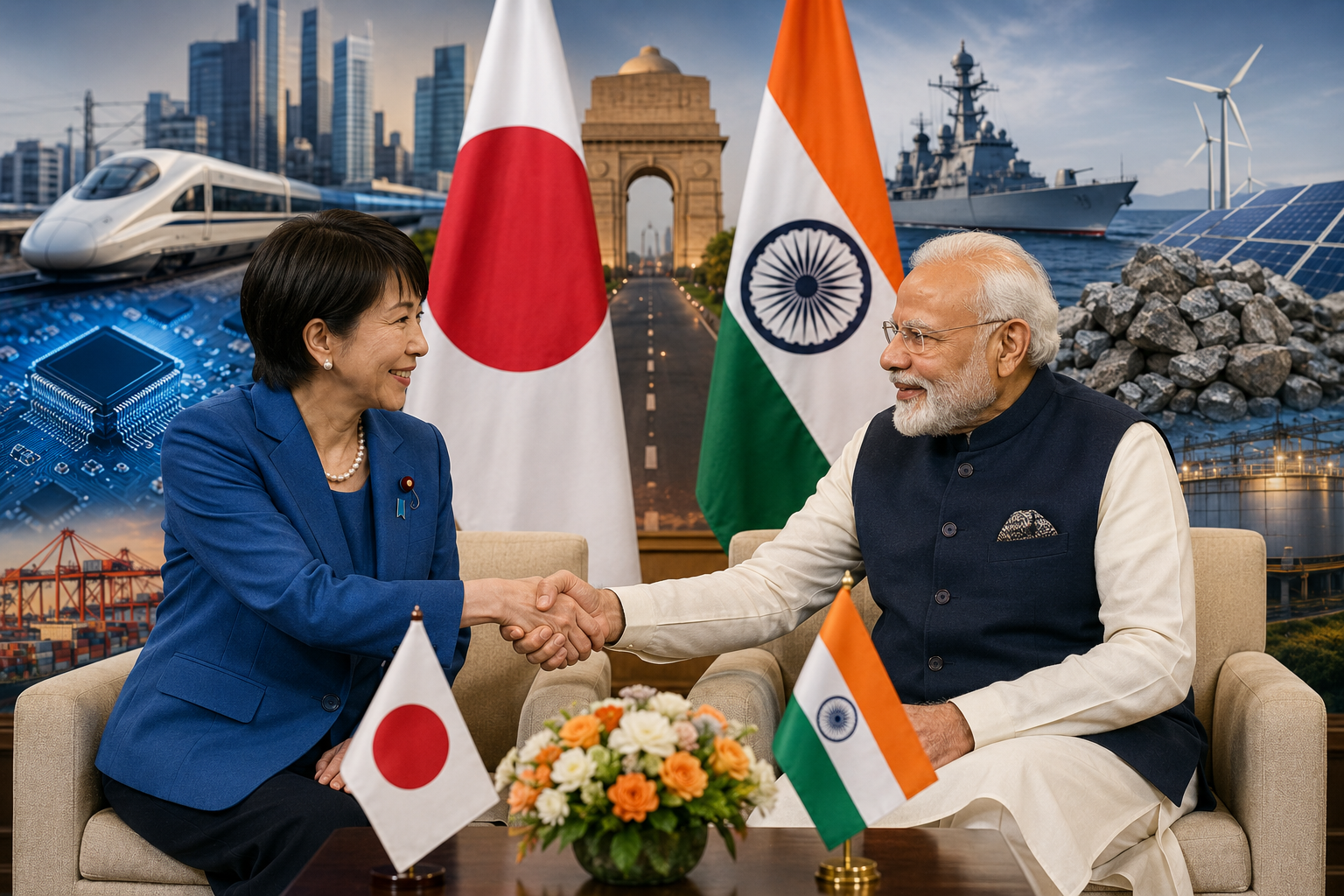
Annual summit expected to deepen cooperation in defence, semiconductors, critical minerals, energy security, resilient supply chains, and investment as India and Japan seek to strengthen economic and strategic ties amid evolving global geopolitics.
India and Japan are set to take another major step in strengthening their long-standing strategic partnership as Prime Minister Narendra Modi hosts Japanese Prime Minister Sanae Takaichi for the annual India-Japan Summit in New Delhi. Against the backdrop of increasing geopolitical uncertainty and shifting global supply chains, the summit is expected to focus on expanding cooperation across strategic, economic, technological, and security-related sectors.
The concept of a "Free and Open Indo-Pacific" (FOIP) is expected to dominate discussions between the two leaders, reflecting the growing convergence of India's and Japan's strategic interests in maintaining regional stability, securing maritime trade routes, and building resilient economic partnerships.
Apart from defence and security, the summit is likely to deliver fresh momentum to collaboration in semiconductor manufacturing, critical minerals, clean energy, digital technologies, infrastructure development, and bilateral investments.
Indo-Pacific Strategy Takes Centre Stage
The Indo-Pacific has emerged as one of the world's most strategically important regions, accounting for a significant share of global trade, manufacturing, and maritime commerce.
India and Japan share a common vision of ensuring that the region remains free, open, inclusive, and governed by international rules. Both countries have consistently advocated freedom of navigation, peaceful resolution of disputes, and stronger regional connectivity.
With geopolitical competition intensifying across Asia, the summit is expected to strengthen coordination on maritime security, defence cooperation, intelligence sharing, and regional stability.
Analysts believe closer India-Japan collaboration will contribute to balancing strategic interests while supporting broader economic growth across the Indo-Pacific.
Defence Cooperation Set for Further Expansion
Defence remains one of the fastest-growing pillars of bilateral relations.
The two countries are expected to discuss expanding military cooperation, defence technology partnerships, joint research, capacity building, and regular bilateral and multilateral military exercises.
As India continues to strengthen its domestic defence manufacturing ecosystem under the 'Make in India' initiative, Japanese technology and industrial expertise could open new opportunities for collaboration in advanced defence systems.
Both governments are also expected to explore greater cooperation in cyber security, space technology, maritime surveillance, and critical infrastructure protection.
Semiconductors and Critical Minerals Become Strategic Priorities
One of the key themes of the summit will be strengthening supply chains for semiconductors and critical minerals.
The global shortage of semiconductor chips over recent years highlighted the vulnerability of concentrated supply chains, prompting several countries to diversify production capabilities.
India and Japan are expected to deepen cooperation in semiconductor manufacturing, technology transfer, research and development, and skilled workforce development.
In addition, both countries aim to reduce dependence on limited global suppliers for critical minerals such as lithium, cobalt, nickel, and rare earth elements, which are essential for electric vehicles, renewable energy systems, batteries, electronics, and defence equipment.
Developing diversified and resilient supply chains has become a strategic priority for both economies.
Energy Security and Clean Energy Collaboration
Energy security is expected to feature prominently during the summit.
Japan has expressed interest in supporting India's efforts to strengthen its strategic petroleum reserves, enhancing the country's ability to withstand global supply disruptions and crude oil price volatility.
Beyond conventional energy, discussions are expected to cover renewable energy, green hydrogen, battery storage technologies, energy-efficient infrastructure, and carbon reduction initiatives.
Both countries see clean energy cooperation as an important pillar of future economic growth and climate resilience.
Local Currency Settlement Could Boost Bilateral Trade
A major economic initiative under discussion is the possibility of introducing a local currency settlement mechanism for bilateral trade.
The proposed framework would allow businesses to conduct transactions directly in the Indian Rupee and Japanese Yen, reducing dependence on third-country currencies for cross-border payments.
Such a mechanism could lower foreign exchange costs, reduce transaction risks, improve settlement efficiency, and encourage greater trade and investment between the two countries.
As global trade increasingly moves toward diversified payment systems, local currency settlements are gaining importance among major economies.
Japanese Investments Continue to Expand in India
Japan remains one of India's most significant long-term investment partners.
During Prime Minister Modi's visit to Japan in 2025, Japan committed to mobilising ¥10 trillion in private investments over the next decade.
These investments are expected to support manufacturing, industrial corridors, logistics, transportation, renewable energy, digital infrastructure, advanced technology, and innovation across India.
Several projects are also planned for India's northeastern region, reflecting Japan's continued commitment to regional connectivity and infrastructure development.
The visiting delegation includes around 50 leading Japanese business executives, highlighting the strong commercial focus of the summit.
Growing Partnership Across Multiple Sectors
India and Japan have steadily broadened their strategic partnership over the years.
Today, bilateral cooperation extends across more than 70 institutional dialogue mechanisms, covering defence, trade, investment, infrastructure, education, digital technology, healthcare, clean energy, science, culture, and people-to-people exchanges.
As the two countries prepare to celebrate 75 years of diplomatic relations in 2027, both governments are seeking to transform their relationship into one of the most comprehensive strategic partnerships in the Indo-Pacific region.
The Japan-India Joint Vision for the Next Decade, announced in 2025, continues to serve as the roadmap for expanding collaboration in emerging technologies, economic security, and sustainable development.
Why the Summit Matters for India
For India, stronger ties with Japan offer multiple strategic and economic advantages.
Japanese investments support industrial growth, infrastructure development, employment generation, and technology transfer. Collaboration in semiconductors, critical minerals, and advanced manufacturing also strengthens India's ambitions to become a global manufacturing hub.
Closer defence and maritime cooperation enhances India's strategic position in the Indo-Pacific while contributing to regional stability.
At the same time, expanding bilateral trade and investment can reduce supply chain vulnerabilities and create new opportunities for Indian businesses in one of Asia's most advanced economies.
Outlook
The Modi-Takaichi summit comes at a crucial time when nations across the world are redefining economic partnerships and strategic alliances in response to changing geopolitical realities. With discussions expected to cover defence, semiconductors, critical minerals, renewable energy, supply chain resilience, digital innovation, and local currency trade, the summit has the potential to significantly elevate India-Japan relations.
If key proposals translate into concrete agreements, the partnership could accelerate investment flows, strengthen technology collaboration, improve economic resilience, and reinforce the shared vision of a free, secure, and prosperous Indo-Pacific. As both nations continue to deepen cooperation, the India-Japan strategic partnership is poised to play an increasingly influential role in shaping the future economic and security architecture of the Asia-Pacific region.