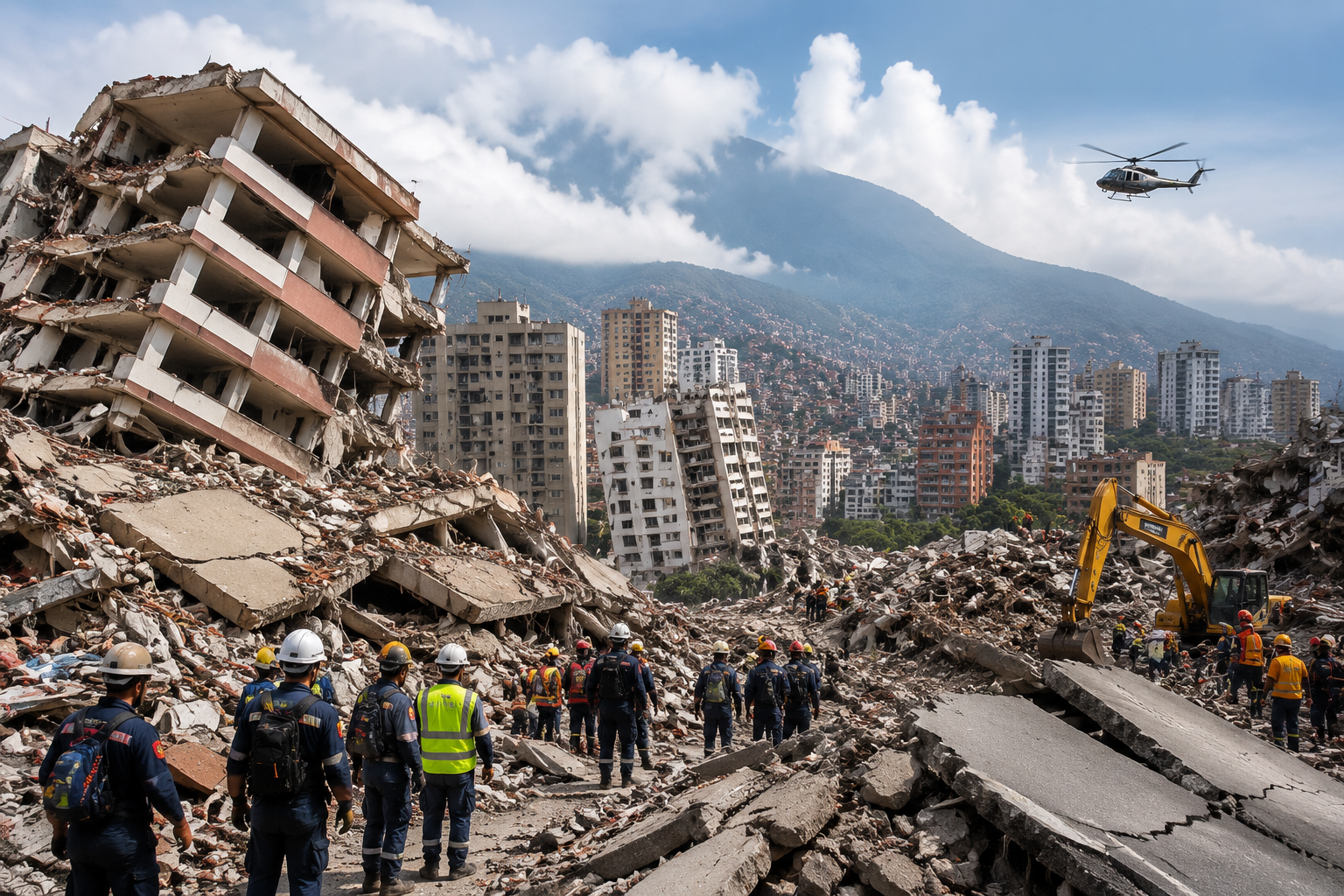
International aid pours into Venezuela as thousands remain displaced, critical infrastructure slowly recovers and authorities race against time to locate missing survivors after twin powerful earthquakes.
Venezuela is facing one of the worst humanitarian disasters in its modern history after last week's twin earthquakes devastated large parts of the country, leaving nearly 2,000 people dead, thousands injured and tens of thousands displaced from their homes. Although aftershocks have begun to weaken, rescue teams continue to search through collapsed buildings amid fears that the death toll could rise further as many people remain unaccounted for.
The two powerful earthquakes, measuring 7.2 and 7.5 on the Richter scale, struck within less than a minute of each other on June 24, causing widespread destruction across the coastal state of La Guaira, parts of Caracas, and several neighboring regions. Entire neighborhoods suffered extensive structural damage, while roads, communication networks and public infrastructure were severely affected.
As emergency operations move from immediate rescue efforts toward long-term recovery, the disaster has prompted one of the largest international humanitarian responses ever seen in Venezuela.
Death Toll Continues to Rise Amid Ongoing Search Operations
Speaking during a televised briefing, National Assembly President Jorge Rodríguez confirmed that the official death toll has climbed to nearly 2,000, while rescue workers continue clearing debris in the worst-hit areas.
Government officials reported that:
-
Nearly 20,000 people have been rescued or survived the disaster.
-
More than 10,000 individuals have sustained injuries ranging from minor trauma to critical conditions.
-
Approximately 15,000 residents have been forced to leave their homes and seek temporary shelter.
Authorities have yet to release an official figure for missing persons. However, opposition groups estimate that more than 40,000 people remain unaccounted for, highlighting the enormous scale of the disaster and the challenges facing rescue agencies.
Heavy machinery, rescue dogs and specialized search teams continue working around the clock in an effort to locate survivors trapped beneath collapsed buildings.
Twin Earthquakes Trigger Widespread Infrastructure Damage
The back-to-back earthquakes caused catastrophic damage across several sectors of Venezuela's infrastructure.
Among the worst-affected facilities were:
-
Residential apartment complexes.
-
Hospitals and public buildings.
-
Bridges and highways.
-
Water supply systems.
-
Electricity transmission infrastructure.
-
Venezuela's primary international airport.
Numerous buildings either collapsed completely or suffered structural damage severe enough to render them unsafe for occupation.
Transportation disruptions initially hampered rescue operations, although military engineers and emergency workers have reopened several critical access routes over recent days.
Global Humanitarian Assistance Expands
The scale of destruction has mobilized a broad international response.
According to Venezuelan authorities, rescue personnel from more than 50 countries are currently assisting local emergency teams.
International support includes:
-
Urban search-and-rescue specialists.
-
Medical professionals.
-
Structural engineering experts.
-
Emergency logistics teams.
-
Humanitarian relief organizations.
-
Large shipments of medicines, food, drinking water and temporary shelters.
Several international agencies have also deployed portable hospitals, emergency communication equipment and psychological support teams to assist survivors.
The humanitarian effort continues to expand as additional aid flights arrive from countries across the Americas, Europe and Asia.
Temporary Shelters House Thousands of Families
Thousands of displaced residents are currently living in government-operated emergency shelters.
Officials confirmed that 69 temporary shelters are now operating nationwide, including:
-
14 shelters in La Guaira.
-
55 additional shelters across Caracas, Miranda and surrounding regions.
The government has announced plans to gradually relocate families from emergency camps into more permanent housing as reconstruction efforts begin.
Providing clean drinking water, sanitation, medical care and education for displaced children remains a priority for relief agencies.
Utilities Slowly Return Across Affected Regions
Authorities reported encouraging progress in restoring essential public services.
Electricity has now been restored to almost the entire La Guaira region, allowing hospitals, emergency centers and businesses to resume limited operations.
However, communication services remain partially disrupted.
Current network availability stands at approximately:
-
Movistar: 27%
-
Digitel: 64%
-
Movilnet: 24%
-
CANTV: 70%
Telecommunication providers continue repairing damaged towers and fiber-optic infrastructure to reconnect affected communities.
Fear Persists Despite Declining Aftershocks
Although seismic experts have observed a decline in both the frequency and intensity of aftershocks, public anxiety remains widespread.
A powerful aftershock earlier this week forced many residents to evacuate buildings once again, reinforcing concerns about further seismic activity.
Across Caracas and neighboring regions, many families continue to:
-
Sleep outdoors or in temporary shelters.
-
Keep emergency kits ready.
-
Leave homes only briefly to collect essential belongings.
-
Avoid re-entering damaged structures.
Authorities have urged citizens to remain alert while following official safety advisories.
Signs of Economic Activity Slowly Returning
While rescue operations continue, parts of Caracas that escaped major structural damage are gradually returning to normal.
Several businesses have reopened, including:
-
Restaurants.
-
Bakeries.
-
Grocery stores.
-
Automotive service centers.
-
Retail outlets.
Commercial activity has resumed in relatively unaffected districts such as El Hatillo and Bello Monte, although consumer activity remains subdued as residents continue coping with the emotional and financial impact of the disaster.
Political Uncertainty Adds Complexity
The earthquake has unfolded against a backdrop of ongoing political tensions.
Acting President Delcy Rodríguez has overseen emergency response efforts while maintaining centralized control over government communications.
Meanwhile, opposition leader María Corina Machado remains in Panama after unsuccessful attempts to return to Venezuela following her departure during political unrest in 2025.
She has pledged to return as soon as circumstances permit, while observers believe the government's handling of the humanitarian crisis may influence Venezuela's political landscape in the months ahead.
Reconstruction Expected to Require Years
Experts believe rebuilding damaged infrastructure will require significant financial resources and sustained international support.
Priority reconstruction projects include:
-
Housing redevelopment.
-
Airport repairs.
-
Restoration of transport networks.
-
Water and sanitation systems.
-
Healthcare facilities.
-
Schools and public institutions.
The disaster is expected to place additional pressure on Venezuela's already fragile economy, making external funding and international cooperation increasingly important during the recovery phase.
Economic Impact Could Extend Beyond Venezuela
Beyond the humanitarian tragedy, the earthquakes are likely to have broader economic implications for the region.
Disruptions to logistics, transportation and commercial activity could temporarily affect regional trade, while reconstruction efforts are expected to increase demand for construction materials, engineering services and infrastructure investment.
Insurance claims, government spending and international financial assistance are also expected to play a significant role in shaping Venezuela's economic recovery over the coming years.
Outlook
Although the gradual reduction in aftershocks has provided some relief, Venezuela's immediate priorities remain rescue operations, humanitarian assistance and restoring essential services. With thousands still displaced and many people unaccounted for, the coming weeks will be crucial in determining the full human and economic impact of the disaster.
International cooperation, effective reconstruction planning and political stability will ultimately determine how quickly the country can recover from one of the most devastating natural disasters in its recent history.