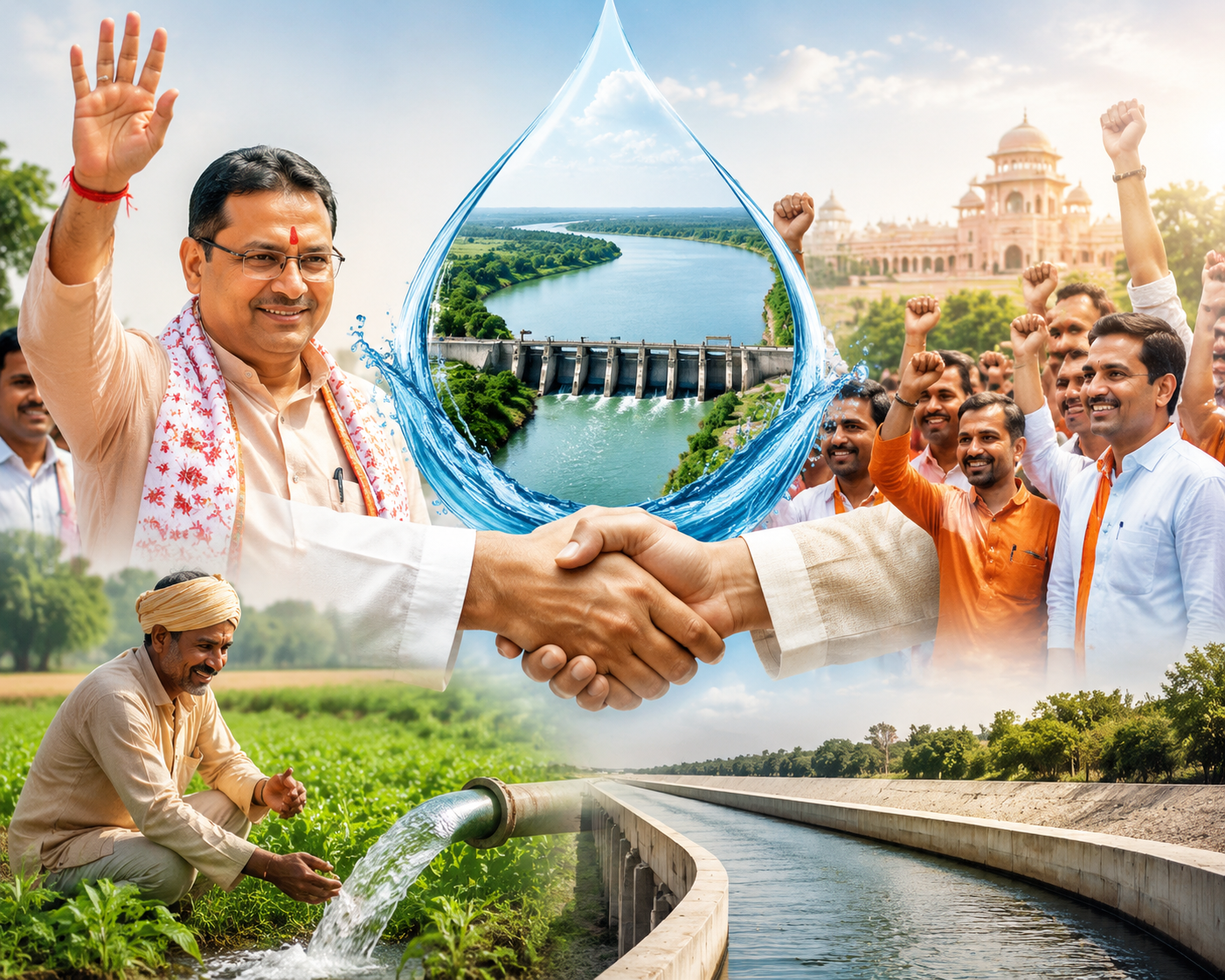
Historic Rajasthan-Haryana Agreement Expected to Improve Water Security and Boost Development in Shekhawati
Rajasthan Chief Minister Bhajanlal Sharma received a grand welcome at Jaipur International Airport on Tuesday after returning from New Delhi, where Rajasthan and Haryana signed a landmark Memorandum of Understanding (MoU) to implement the long-pending 1994 Upper Yamuna River Board (UYRB) agreement. Senior BJP leaders, party workers, and supporters hailed the development as a major achievement that could significantly strengthen Rajasthan's water infrastructure.
The agreement is expected to provide long-term relief to the water-scarce Shekhawati region, which has faced persistent challenges related to drinking water availability and irrigation for decades. The implementation of the pact is seen as a strategic move toward ensuring better utilization and sharing of Yamuna river water between the two neighbouring states.
Senior BJP Leaders Extend Warm Welcome
Upon his arrival in Jaipur, the Chief Minister was welcomed by BJP Rajasthan President Madan Rathore, Deputy Chief Minister Prem Chand Bairwa, former Leader of Opposition Rajendra Rathore, several cabinet colleagues, legislators, and hundreds of BJP workers. Supporters from the Shekhawati region gathered in large numbers, expressing optimism that the agreement would bring meaningful change to their districts.
Party leaders described the MoU as an important milestone in Rajasthan's efforts to secure sustainable water resources. They praised the state government's coordination with Haryana and the Centre in reviving the implementation of an agreement that had remained pending for many years.
Focus on Water Security and Regional Growth
The Shekhawati region, comprising districts such as Sikar, Jhunjhunu, and Churu, has historically struggled with groundwater depletion and limited surface water availability. The new agreement is expected to strengthen drinking water projects, improve irrigation facilities, and reduce dependence on overexploited groundwater reserves.
Officials believe the implementation of the Upper Yamuna River Board agreement will help create a more reliable water supply system, benefiting both rural communities and urban centres. Better water availability could also support agricultural productivity, industrial development, and economic growth across the region.
Boost to Infrastructure and Agriculture
Water experts note that improved river water allocation can have far-reaching economic benefits. Enhanced irrigation infrastructure can increase crop yields, encourage diversification into high-value crops, and provide greater stability to farmers facing erratic rainfall patterns.
The agreement is also expected to complement Rajasthan's ongoing investments in water conservation, pipeline networks, and irrigation modernization. Together, these initiatives could strengthen the state's long-term water resilience and support sustainable development goals.
Political and Economic Significance
The successful signing of the MoU is being viewed as an example of cooperative federalism, with neighbouring states working together to address shared resource challenges. Political observers believe the agreement strengthens Rajasthan's long-term planning for water management while reinforcing confidence in infrastructure-led development.
For investors and businesses, improved water availability is an important factor supporting industrial expansion, agriculture-based industries, and rural economic development. Reliable water resources often contribute to better infrastructure planning and can enhance the investment attractiveness of regions facing resource constraints.
Outlook
With the agreement now in place, attention will shift to the timely implementation of the Upper Yamuna River Board provisions and the execution of related infrastructure projects. If implemented effectively, the pact has the potential to transform water availability in the Shekhawati region, improve the quality of life for millions of residents, and contribute to Rajasthan's broader economic and agricultural growth agenda.