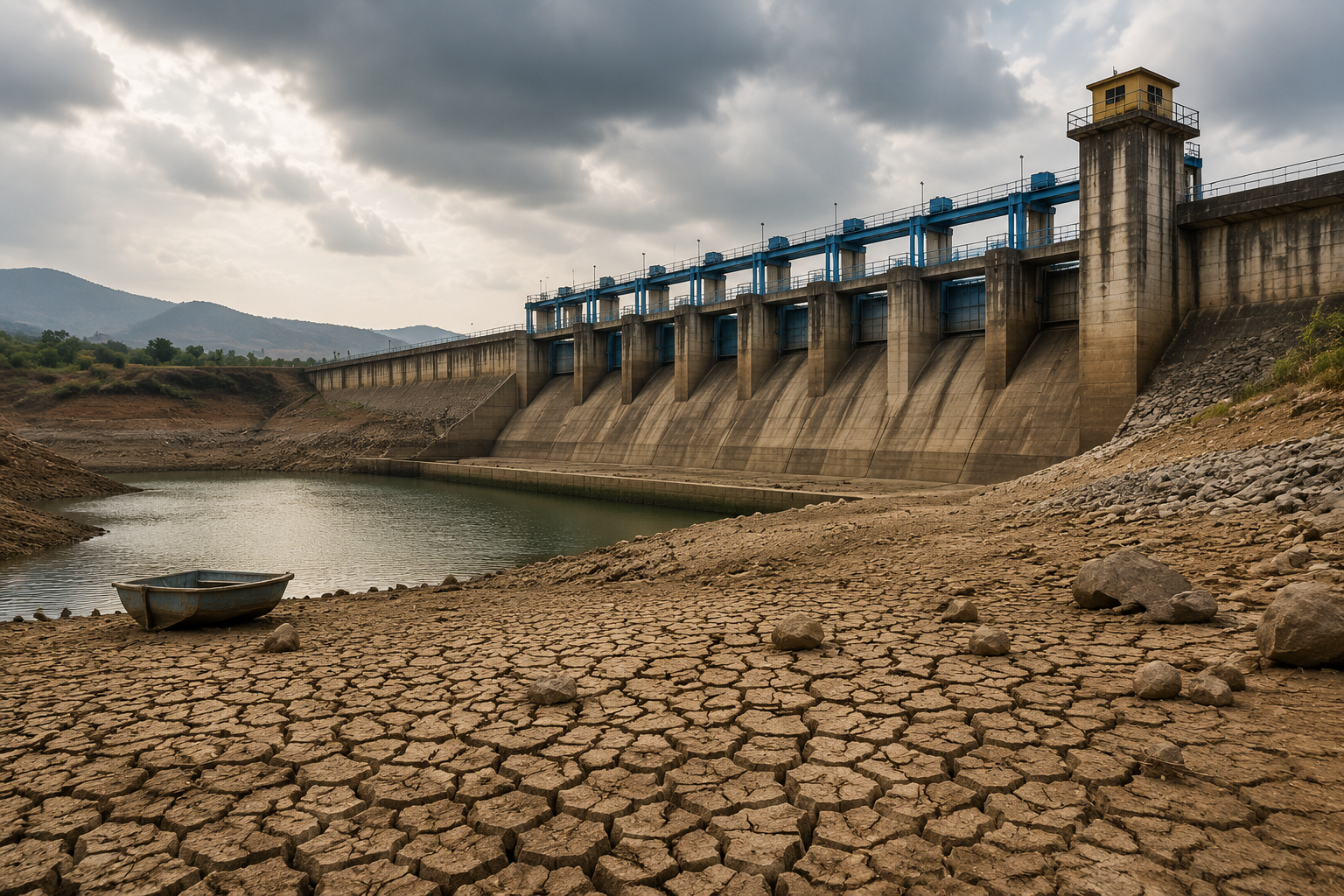
Rainfall Deficit Leaves Two Reservoirs Nearly Dry, Heightening Risks for Agriculture, Drinking Water Supply and Rural Economy
A sluggish start to the southwest monsoon has intensified water stress across Maharashtra's Marathwada region, with water storage in its 11 major reservoirs declining to just 33.59% of total live capacity. The sharp fall in reservoir levels, coupled with below-normal rainfall during June, has raised fresh concerns over irrigation, drinking water availability and the progress of the ongoing kharif sowing season.
Marathwada, one of India's most drought-prone regions, depends heavily on monsoon rainfall to replenish its reservoirs and sustain agriculture. With rainfall remaining below normal in the opening month of the monsoon, officials are closely monitoring the situation as farmers await improved showers in July.
June Rainfall Falls Short of Seasonal Average
According to official data, Marathwada received 103.1 mm of rainfall in June, which is only 79.6% of the normal monthly average of 129.5 mm.
The delayed arrival and uneven distribution of rainfall significantly reduced inflows into reservoirs, limiting water accumulation at a crucial time when storage levels typically begin improving.
The rainfall deficit has affected all eight districts of Marathwada, increasing dependence on existing reservoir reserves for domestic and agricultural needs.
Reservoir Storage Drops Below Last Year's Level
The region's 11 major irrigation projects together have a live storage capacity of approximately 182.07 TMC (Thousand Million Cubic Feet).
As of the latest assessment, these reservoirs collectively held only 33.59% of their total capacity.
During the corresponding period last year, storage stood at 42.85%, indicating a substantial year-on-year decline in available water resources.
The lower storage reflects weak reservoir inflows during the initial phase of the southwest monsoon and highlights the importance of strong rainfall during July and August.
Two Reservoirs Reach Critical Condition
Among the major irrigation projects, the situation is particularly alarming in Dharashiv and Hingoli districts.
The Sina Kolegaon reservoir has reportedly entered negative live storage levels, effectively indicating that its usable water reserves have been exhausted.
Meanwhile, the Siddheshwar reservoir has almost completely dried up after recording a significant decline compared to the previous year.
These developments underscore the vulnerability of drought-prone regions during periods of below-normal monsoon activity.
Storage Levels Across Major Dams
Water availability remains uneven across Marathwada's major reservoirs.
Current storage levels include:
-
Jayakwadi: 28.03%
-
Majalgaon: 18.75%
-
Manjara: 19.12%
-
Nimna Dudhna: 25.50%
-
Yeldari: 51.70%
-
Penganga: 44.97%
-
Manar: 40.49%
-
Nimna Terna: 35.06%
-
Vishnupuri: 36.51%
Although reservoirs such as Yeldari and Penganga continue to maintain relatively comfortable storage, several others remain well below desirable levels for this stage of the monsoon.
Agriculture Faces Rising Uncertainty
The timing of the rainfall deficit has become particularly significant because it coincides with the beginning of the kharif cropping season.
Marathwada is a major producer of:
-
Soybean
-
Cotton
-
Tur (Pigeon Pea)
-
Maize
-
Bajra
-
Pulses
Most of these crops rely heavily on timely monsoon rainfall for sowing and early growth.
Insufficient rainfall during June has already delayed sowing in several areas, and continued weak precipitation could affect crop acreage, productivity and farm incomes.
Drinking Water Supply Under Pressure
Beyond agriculture, reservoirs play a crucial role in supplying drinking water to millions of people across the region.
Urban centres, rural villages and municipal corporations depend on these irrigation projects for year-round water supply.
If reservoir inflows fail to improve over the coming weeks, local administrations may need to implement stricter water management measures, including controlled water releases and conservation initiatives, to ensure uninterrupted drinking water availability.
Industrial Activity May Also Feel the Impact
Industrial units operating in Marathwada also rely on reservoir water for manufacturing processes.
Lower water availability could eventually lead to restrictions on industrial allocations, particularly if monsoon conditions remain weak during the remainder of the season.
Water-intensive industries may therefore need to adopt more efficient water management practices or seek alternative sources if reservoir levels continue to decline.
Importance of July and August Rainfall
Meteorologists note that the majority of Maharashtra's seasonal rainfall is usually received during July and August.
A revival in monsoon activity during these months could substantially improve reservoir storage and ease pressure on agriculture and drinking water supplies.
Conversely, an extended period of below-normal rainfall may increase dependence on groundwater, raise irrigation costs and elevate the risk of drought-like conditions in vulnerable districts.
The next few weeks are therefore expected to play a decisive role in determining the region's overall water security.
Authorities Intensify Monitoring
State irrigation and agriculture departments are continuously monitoring reservoir inflows, rainfall distribution and sowing progress across Marathwada.
Officials are reviewing district-level water availability and preparing contingency plans to ensure efficient utilisation of available resources.
Efforts are also underway to encourage water conservation, efficient irrigation practices and judicious reservoir management to minimise the impact of any prolonged rainfall deficit.
Economic Implications
Marathwada's water situation has implications extending beyond agriculture.
Reduced reservoir storage can influence:
-
Food grain production
-
Cotton and soybean output
-
Rural employment
-
Farm incomes
-
Food inflation
-
Industrial production
-
Groundwater extraction
-
Government expenditure on drought relief
A prolonged weak monsoon could also affect rural consumption and overall economic activity in one of Maharashtra's key agricultural regions.
Outlook
The decline in reservoir storage to 33.59% serves as an early warning of the challenges posed by an uneven monsoon in Marathwada.
While the region still has sufficient reserves to meet immediate requirements in many areas, sustained rainfall during July will be essential to replenish reservoirs, support crop cultivation and secure drinking water supplies.
For farmers, policymakers and businesses alike, the progress of the southwest monsoon over the coming weeks will remain the single most important factor shaping Marathwada's agricultural output, water security and regional economic outlook for the remainder of the year.