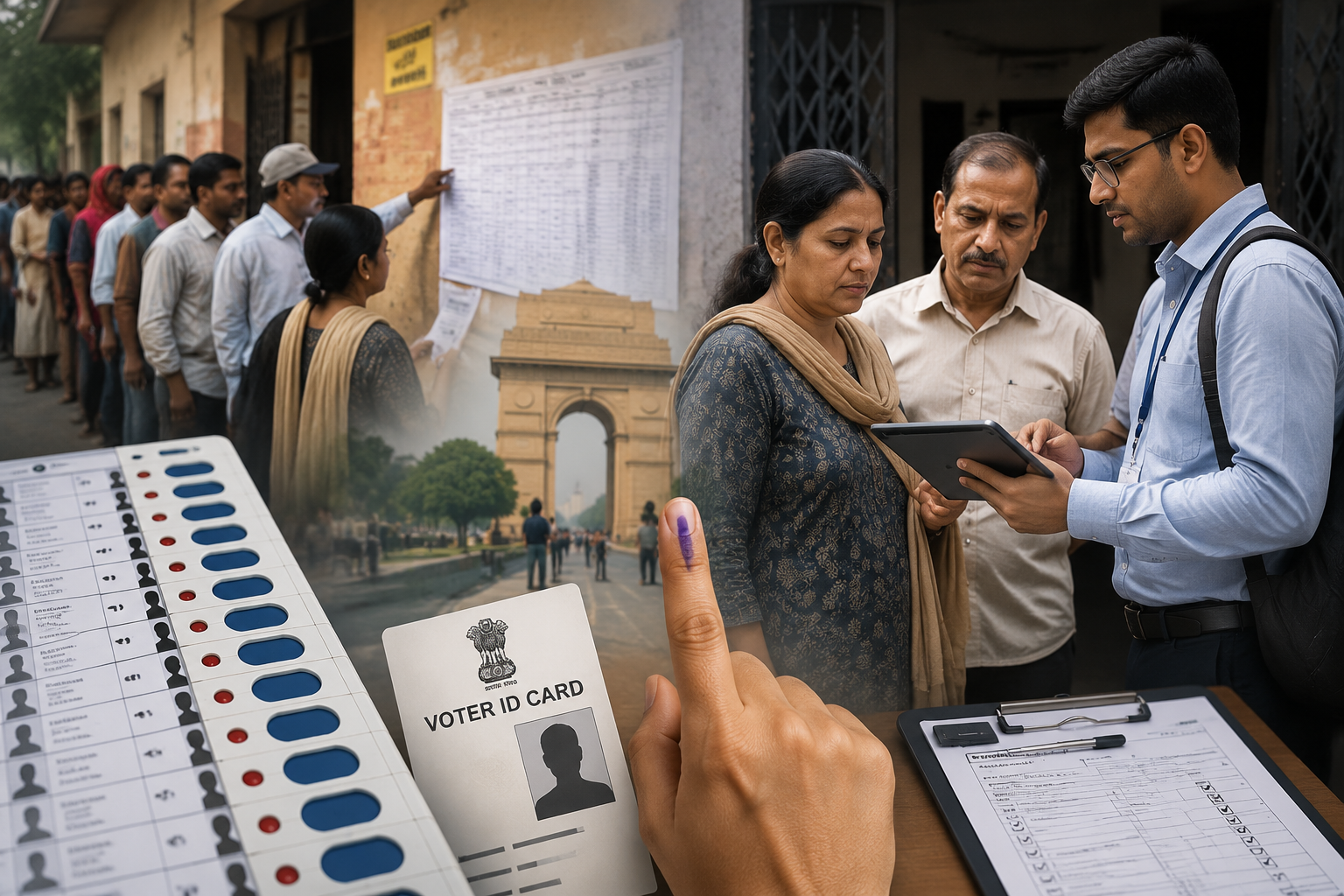
Election Commission Begins Month-Long Door-to-Door Verification to Ensure Accurate Electoral Rolls Ahead of Upcoming Elections
The Election Commission of India (ECI) has commenced a comprehensive Special Intensive Revision (SIR) of Delhi's electoral rolls, launching one of the largest voter verification exercises ever undertaken in the national capital. Beginning today, more than 13,000 Booth Level Officers (BLOs) will conduct door-to-door verification of nearly 1.45 crore registered voters to update electoral records, identify eligible new voters and remove duplicate or ineligible entries.
The month-long exercise, which will continue until July 29, is aimed at ensuring that Delhi's voter database remains accurate, transparent and up to date before future elections. The revised electoral rolls will strengthen the integrity of the electoral process while enabling eligible citizens to participate without administrative hurdles.
What is the Special Intensive Revision (SIR)?
The Special Intensive Revision is a detailed verification process undertaken periodically by the Election Commission to improve the quality of electoral rolls.
Unlike routine updates, the SIR involves physical verification of voters through household visits by Booth Level Officers. The objective is to confirm that every registered voter remains eligible while ensuring that no qualified citizen is left out of the electoral roll.
The exercise is currently being carried out across 16 states and three Union Territories as part of a nationwide effort to maintain clean and error-free electoral records.
Door-to-Door Verification Begins
As part of the campaign, Booth Level Officers will visit every household within their designated polling areas.
During the first visit, BLOs will distribute enumeration forms and guide residents on how to complete the required information. A second visit will be conducted to collect the completed forms.
If a residence is found locked, officials will leave the forms and make multiple follow-up visits. Where forms remain unreturned, BLOs may conduct local inquiries to determine whether the voter has shifted permanently, passed away or has duplicate registration elsewhere.
The Election Commission has clarified that no supporting documents will be collected during this initial stage of the verification process.
Additional Verification in Select Cases
Although most voters will only need to complete the enumeration form, additional verification may be required in specific situations.
Individuals whose names, or whose parents' or grandparents' records, cannot be linked with earlier electoral rolls may be asked to provide supporting documentation during the subsequent verification stage.
Documents that may be requested include:
-
Birth certificate
-
Passport
-
Educational qualification certificate
-
Permanent residence certificate
-
Government-issued identity documents
-
Property or land allotment records
Officials have emphasized that such documentation will only be sought where necessary to establish voter eligibility.
Timeline of the Electoral Roll Revision
The Election Commission has outlined a detailed schedule for completing the revision exercise.
-
July 1 – July 29: Door-to-door voter verification and collection of enumeration forms.
-
August 5: Publication of the draft electoral roll.
-
August 5 – September 4: Filing of claims and objections by voters.
-
August 5 – October 3: Verification, hearings and disposal of objections.
-
October 10: Publication of the final electoral roll.
The final electoral roll will be used for all future elections conducted in Delhi until the next revision cycle.
What Every Voter Should Check
The Election Commission has urged residents to verify several important details during the revision process.
Voters should ensure that:
-
Their name appears correctly in the electoral roll.
-
Residential address is accurate.
-
Assigned polling station details are correct.
-
Duplicate voter registrations are removed.
-
Names of deceased family members are deleted.
-
Newly eligible family members above 18 years are enrolled.
Timely verification will help prevent complications on polling day.
Opportunity to File Claims and Corrections
Following publication of the draft electoral roll, citizens will be given an opportunity to request additions, corrections or deletions.
If a voter's name is missing, incorrect or proposed for deletion, a formal claim or objection can be submitted before the stipulated deadline.
Electoral Registration Officers (EROs) will examine every application individually and may conduct further field verification wherever required before taking a final decision.
Citizens who remain dissatisfied with an ERO's decision will have the right to appeal before higher election authorities.
Grounds for Removal from the Electoral Roll
The Election Commission has clarified that voter names can only be removed under legally permitted circumstances.
These include:
-
Verified death of the voter.
-
Permanent relocation outside the constituency.
-
Duplicate voter registration.
-
Non-residence at the registered address.
-
Other statutory disqualifications under electoral law.
Except in confirmed cases such as death, affected voters will receive prior notice and an opportunity to respond before any deletion is finalized.
Technology and Field Verification Work Together
The revision exercise combines digital voter databases with extensive field-level verification to improve the accuracy of electoral records.
Booth Level Officers play a critical role in validating residential details while identifying discrepancies that cannot be detected through digital records alone.
The Election Commission believes this combination of technology and physical verification strengthens transparency and enhances public confidence in the electoral process.
Significance for Democratic Governance
An accurate electoral roll forms the backbone of every democratic election.
By ensuring that only eligible voters are included while removing duplicate and outdated entries, the Election Commission aims to strengthen the credibility of elections and improve administrative efficiency.
The exercise also ensures that newly eligible young voters receive an opportunity to participate in the democratic process, while minimizing errors that could otherwise affect polling operations.
Outlook
The Special Intensive Revision marks a significant administrative initiative involving thousands of election officials and millions of voters across Delhi.
As the verification process progresses over the coming weeks, active cooperation from residents will play a crucial role in ensuring the success of the exercise.
With the draft electoral roll scheduled for publication in August and the final list expected in October, the revision is set to create a more accurate, transparent and inclusive voter database ahead of future elections.
For citizens, promptly completing verification formalities and reviewing electoral details will be the most effective way to safeguard their voting rights and ensure seamless participation in the democratic process.