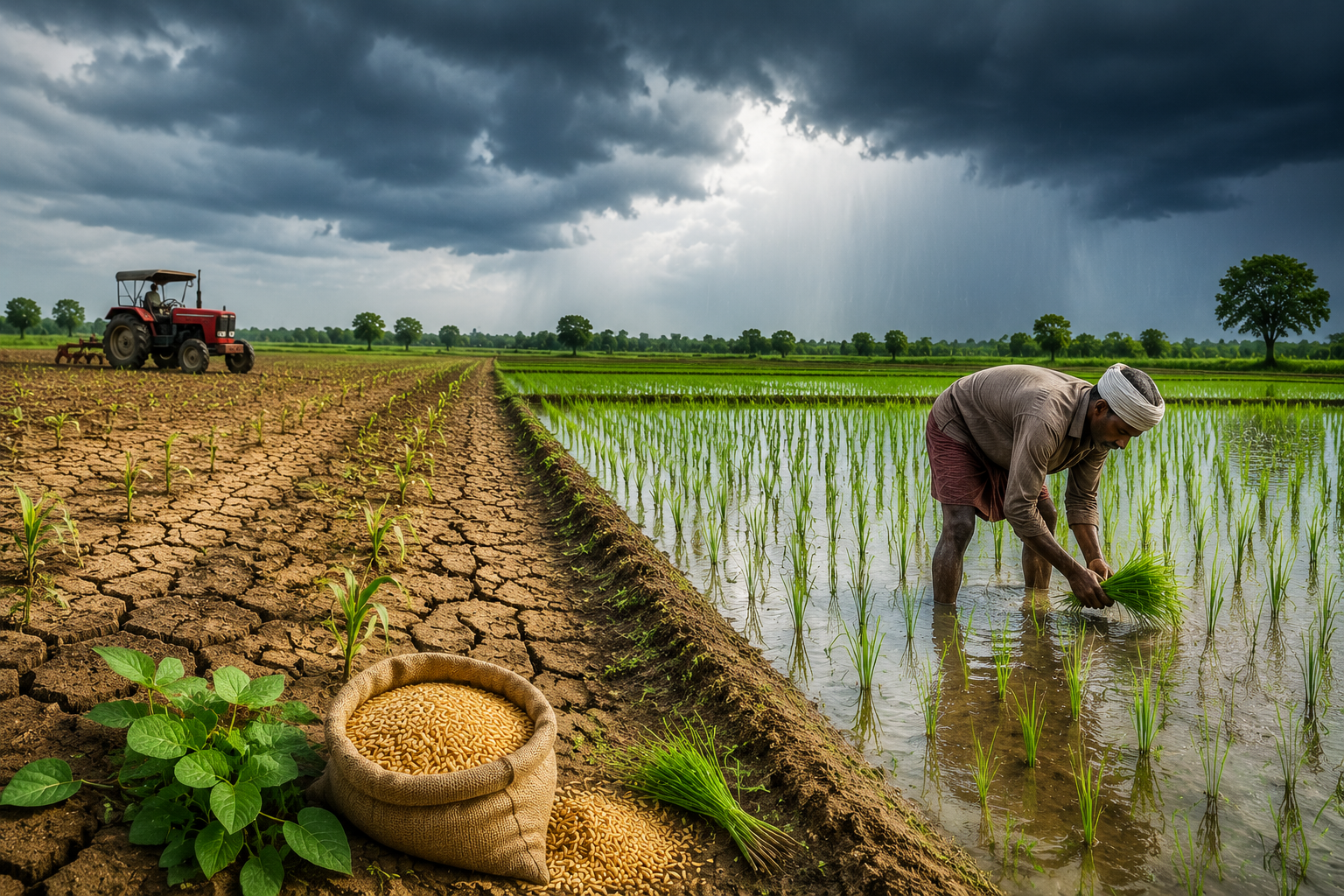
Weak Rainfall Across Key Agricultural Regions Raises Concerns Over Crop Production, Rural Economy and Food Inflation
India's 2026 kharif sowing season has begun on a weak note as delayed and uneven southwest monsoon rains continue to disrupt agricultural activities across several states. According to the latest data released by the Ministry of Agriculture, the total area under kharif cultivation has reached 18.27 million hectares, a decline of 23% compared with 23.65 million hectares during the same period last year.
The delayed onset of monsoon has affected the sowing of almost all major kharif crops, including paddy, pulses, oilseeds, coarse cereals and cotton, raising concerns over agricultural output, rural incomes and food inflation in the coming months.
Paddy Sowing Records Significant Decline
Rice, India's most important kharif crop, has witnessed one of the sharpest declines in sowing this season.
As of the latest reporting period, paddy cultivation covered 2.58 million hectares, compared with 3.44 million hectares during the corresponding period last year, reflecting a decline of over 25%.
The delayed arrival of monsoon rains has prevented farmers in several key producing states from preparing fields and transplanting seedlings on schedule.
Since paddy cultivation is highly dependent on adequate early-season rainfall, any prolonged delay could impact production if weather conditions fail to improve in the coming weeks.
Pulses and Oilseeds Face Steep Slowdown
Pulses have also recorded a substantial decline in acreage.
Total sowing under pulses has fallen by more than 30%, with tur (arhar) registering one of the steepest reductions among major pulse crops.
Oilseed cultivation has witnessed an even sharper contraction.
The total area under oilseeds has dropped by more than 50%, primarily due to lower sowing of soybean and groundnut, two of India's most important oilseed crops.
Central India, which accounts for a large share of soybean production, has experienced significant rainfall deficits, delaying field operations and affecting planting decisions.
Cotton and Coarse Cereals Also Impacted
Cotton cultivation has declined by nearly 35%, while acreage under coarse cereals, including maize, bajra and jowar, has also fallen compared to the previous year.
Although the sowing window remains open for several crops, delayed planting often shortens the growing season and may affect productivity if rainfall does not normalize soon.
Agricultural economists note that timely rainfall during July will be crucial in determining whether farmers can recover part of the lost acreage.
Sugarcane and Jute Show Relative Stability
Amid the broader slowdown, a few crops have shown resilience.
Sugarcane acreage has registered a marginal increase compared with last year, while jute and mesta have also recorded slight improvements in cultivated area.
These crops are generally less affected by short-term monsoon delays due to their different planting schedules and irrigation availability.
However, continued rainfall remains essential for maintaining healthy crop development throughout the season.
Monsoon Deficit Remains the Biggest Concern
The sluggish pace of sowing is closely linked to below-normal rainfall during June.
According to the India Meteorological Department (IMD), several parts of the country have experienced significant rainfall deficits, particularly in central India, where precipitation has remained substantially below normal.
Eastern, northeastern, southern and northwestern regions have also reported weaker-than-average monsoon activity.
The uneven distribution of rainfall has reduced soil moisture, delaying land preparation and forcing farmers to postpone sowing operations.
El Niño Conditions Add Uncertainty
Weather experts are also monitoring the development of El Niño conditions over the Pacific Ocean.
Historically, El Niño events have often been associated with weaker monsoon performance in India, although their impact varies depending on atmospheric conditions.
If rainfall remains below normal during the peak monsoon months, crop production and rural economic activity could face additional pressure.
Meteorologists, however, continue to assess evolving weather patterns before making definitive seasonal projections.
Reservoir Storage Provides Partial Cushion
Water availability remains a mixed picture across the country.
While overall storage in major reservoirs remains above the long-term average, several reservoirs continue to report below-normal water levels.
Adequate reservoir storage could support irrigation in canal-fed regions, helping mitigate some of the impact of delayed rainfall.
However, rain-fed agricultural areas remain highly dependent on consistent monsoon activity during July and August.
Potential Impact on Inflation and Rural Economy
A prolonged delay in kharif sowing could have broader economic implications.
Lower production of rice, pulses and oilseeds may tighten food supplies later in the year, potentially increasing prices of essential agricultural commodities.
Higher food inflation could influence monetary policy decisions while also affecting household consumption and rural purchasing power.
Agriculture continues to play a vital role in India's economy, and the performance of the kharif season has a direct bearing on rural incomes, consumer demand and overall economic growth.
Government and Farmers Await Improved Rainfall
Agricultural authorities remain optimistic that sowing activity could accelerate if monsoon conditions improve during July.
Historically, a significant portion of kharif planting takes place after widespread rainfall in early July, allowing farmers to recover much of the initial delay.
State governments and agricultural departments are closely monitoring weather developments while advising farmers on suitable crop management practices based on local rainfall conditions.
Outlook
Although the current sowing data reflects a challenging start to the kharif season, the final outcome will largely depend on rainfall distribution over the next four to six weeks.
A timely revival of the southwest monsoon could substantially narrow the existing acreage gap and improve production prospects across major crops.
However, if rainfall remains erratic, concerns over agricultural output, food inflation and rural demand are likely to intensify.
For investors, policymakers and commodity markets, weekly sowing progress, reservoir levels and monsoon performance will remain key indicators to watch as they shape India's agricultural outlook and broader economic trajectory during the remainder of the year.