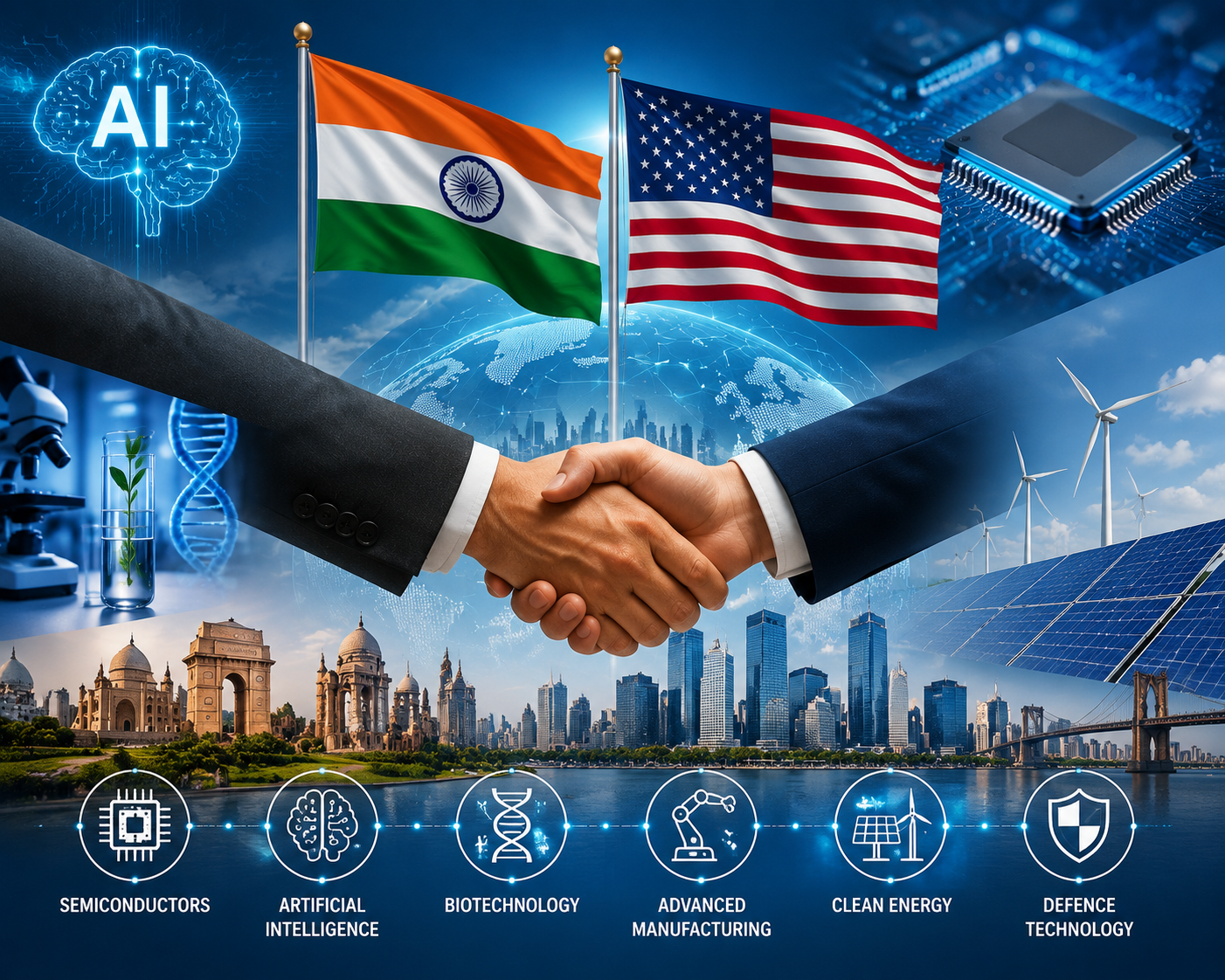
AI, Semiconductors, Biotechnology and Clean Energy to Drive Strategic Cooperation as India Strengthens Its Position as a Global Innovation and Manufacturing Hub
Emerging technologies will become the cornerstone of the next phase of the India–United States strategic partnership, according to India's Ambassador to the US, Vinay Mohan Kwatra, who highlighted artificial intelligence (AI), semiconductors, biotechnology, clean energy and advanced manufacturing as the sectors that will shape bilateral cooperation in the years ahead.
Speaking at the US-India Strategic Partnership Forum (USISPF) Leadership Summit in Washington, D.C., Kwatra said India's rapid economic transformation, robust domestic demand and policy reforms have positioned the country as a preferred destination for global investments and supply chain diversification.
He also projected an ambitious growth trajectory for India, stating that the country's economy is expected to expand from the current USD 4.3 trillion to nearly USD 7 trillion by the end of this decade, USD 14 trillion by the mid-2030s, and potentially USD 25–30 trillion by 2047, making it one of the world's largest economic powers.
Technology to Become the Foundation of Bilateral Cooperation
According to Ambassador Kwatra, the future of India–US relations will be built around collaboration in emerging and strategic technologies.
He identified several high-growth sectors expected to witness deeper cooperation:
- Artificial Intelligence (AI)
- Semiconductor manufacturing
- Biotechnology
- Electronics manufacturing
- Clean energy technologies
- Defence manufacturing
- Digital infrastructure
- Advanced research and innovation
These industries are increasingly becoming central to economic competitiveness, national security and global technological leadership.
India Emerging as a Global Manufacturing Powerhouse
Kwatra said India has successfully established itself as a reliable destination for multinational companies looking to diversify manufacturing operations beyond traditional production centres.
Several factors continue to strengthen India's appeal:
- Stable economic growth.
- Large domestic consumer market.
- Skilled engineering talent.
- Expanding infrastructure.
- Supportive industrial policies.
- Competitive manufacturing ecosystem.
As global companies adopt supply chain diversification strategies, India is becoming an increasingly important production and export hub.
Massive Investments in Strategic Sectors
India has significantly accelerated investments in industries considered critical for long-term economic growth.
These include:
- Semiconductor fabrication.
- Electronics manufacturing.
- Artificial Intelligence.
- Renewable energy.
- Defence production.
- Digital technologies.
- Advanced industrial automation.
Such investments are strengthening India's integration into global value chains while reducing dependence on external manufacturing ecosystems.
India's Economy Set for Rapid Expansion
Highlighting India's long-term economic outlook, Ambassador Kwatra presented an optimistic growth roadmap.
India's Economic Projection
| Timeline | Estimated GDP Size |
|---|---|
| Present | USD 4.3 Trillion |
| By 2030 | USD 7 Trillion |
| Mid-2030s | USD 14 Trillion |
| By 2047 | USD 25–30 Trillion |
If these projections are realised, India will emerge as one of the largest contributors to global economic growth over the next two decades.
Domestic Demand Continues to Power Growth
One of India's biggest economic strengths, according to Kwatra, is its strong domestic demand.
Unlike many export-dependent economies, India's growth is supported by:
- Rising household consumption.
- Expanding middle class.
- Infrastructure spending.
- Digital transformation.
- Manufacturing expansion.
- Increasing formalisation of the economy.
This balanced growth model has helped India consistently outperform many major global economies despite external uncertainties.
An Indispensable Anchor in the Global Economy
Kwatra described India as an "indispensable anchor" for global economic stability during a period marked by geopolitical tensions, supply chain disruptions and slowing global growth.
India's growing importance stems from:
- Political stability.
- Strong economic fundamentals.
- Demographic advantage.
- Technological capabilities.
- Expanding manufacturing base.
- Strategic geographic position.
These strengths are making India an increasingly trusted partner for governments and multinational corporations alike.
Supply Chain Diversification Creating New Opportunities
The global shift toward diversified manufacturing has accelerated following recent geopolitical developments and supply chain disruptions.
India is emerging as a major beneficiary through:
- Production Linked Incentive (PLI) schemes.
- Improved logistics infrastructure.
- Competitive manufacturing costs.
- Policy support for strategic industries.
- Expanding industrial corridors.
Sectors such as electronics, semiconductors, pharmaceuticals and renewable energy are witnessing rising international interest.
Atmanirbhar Bharat Is Globally Connected
Addressing the government's Atmanirbhar Bharat initiative, Ambassador Kwatra clarified that the policy is not designed to isolate India from global markets.
Instead, it focuses on:
- Building globally competitive industries.
- Strengthening domestic manufacturing.
- Encouraging innovation.
- Creating resilient supply chains.
- Expanding exports.
- Supporting international partnerships.
The objective is to improve India's competitiveness while remaining deeply integrated into the global economy.
India–US Partnership Expanding Beyond Trade
While trade continues to remain an important pillar, the bilateral relationship is increasingly expanding into high-value strategic sectors.
Areas witnessing rapid cooperation include:
- Semiconductor ecosystem development.
- Artificial Intelligence research.
- Space technology.
- Defence manufacturing.
- Cybersecurity.
- Quantum technologies.
- Digital Public Infrastructure.
Both countries are investing heavily in these sectors as they become increasingly important for future economic and national security priorities.
Clean Energy and Defence Drive Long-Term Collaboration
Clean energy and defence manufacturing have emerged as additional pillars of the strategic partnership.
Potential areas of cooperation include:
- Green hydrogen.
- Solar manufacturing.
- Electric mobility.
- Aerospace technology.
- Defence co-production.
- Critical mineral supply chains.
These industries are expected to attract substantial investments over the coming decade.
Global Investors Increasingly Bullish on India
India's sustained economic expansion and policy reforms continue to attract strong investor interest.
International companies view India as:
- A high-growth consumer market.
- A reliable manufacturing base.
- A technology innovation hub.
- A strategic export destination.
The country's favourable demographics and expanding infrastructure further strengthen its long-term investment appeal.
Innovation Becoming the New Growth Engine
Innovation is expected to become one of the biggest drivers of India's future economic growth.
Government initiatives supporting:
- Start-ups.
- Research & Development.
- Semiconductor manufacturing.
- AI adoption.
- Digital governance.
are creating an ecosystem that encourages entrepreneurship and technology-led development.
As India moves up the global value chain, knowledge-intensive industries are expected to contribute a larger share of GDP.
Future Outlook
The India–US strategic partnership is expected to deepen significantly over the coming years, particularly in technology-intensive sectors.
Future cooperation is likely to focus on:
- Artificial Intelligence.
- Semiconductors.
- Biotechnology.
- Defence technologies.
- Clean energy.
- Advanced manufacturing.
- Digital infrastructure.
Together, these industries are expected to become key drivers of bilateral investment, innovation and long-term economic growth.