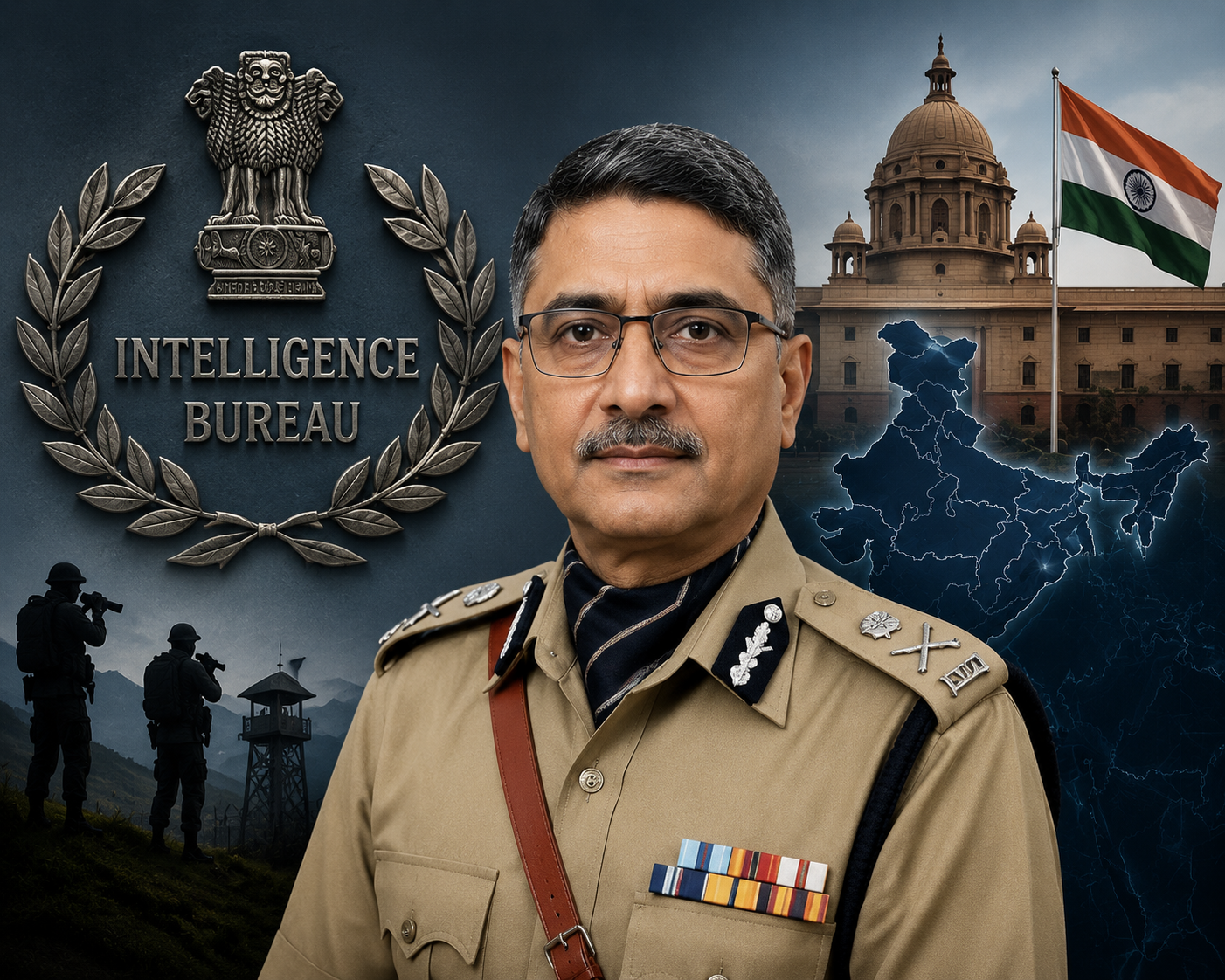
Senior IPS officer to take charge of Intelligence Bureau for a two-year term
The Centre has appointed senior IPS officer Mahesh Dixit as the next Director of the Intelligence Bureau (Intelligence Bureau), marking a significant leadership transition in India’s internal security framework. He will serve a two-year tenure, succeeding outgoing chief Tapan Kumar Deka.
The appointment was cleared by the Appointments Committee of the Cabinet (ACC), chaired by Prime Minister Narendra Modi, according to official government communication.
Smooth Transition at the Top of India’s Intelligence Setup
Outgoing chief Tapan Deka completes extended tenure
Current IB Director Tapan Kumar Deka will complete his extended tenure on June 30, after leading the agency since July 2022. His term focused on strengthening counter-terror operations, inter-agency coordination, and monitoring emerging internal security threats.
With the transition, Mahesh Dixit—currently serving as Special Director in the IB—will take over leadership responsibilities of India’s premier domestic intelligence agency.
Who is Mahesh Dixit?
Experienced intelligence officer with J&K and anti-Naxal exposure
Mahesh Dixit is a 1993-batch IPS officer of the Andhra Pradesh cadre. Over his long career in internal security and intelligence operations, he has handled several high-sensitivity assignments across India.
His key postings include:
- Subsidiary Intelligence Bureau (SIB), Jammu & Kashmir
- Counter-terror intelligence operations in J&K
- Security assignments in the Northeast region
- Anti-Naxal operations in central India
- Strategic postings in Ladakh and border-sensitive zones
He is currently serving as Special Director in the Intelligence Bureau (Intelligence Bureau).
Operational Expertise in Sensitive Security Regions
Strong experience in post-Article 370 security environment
Dixit’s tenure in Jammu and Kashmir is considered one of his most critical assignments, where he played a role in strengthening intelligence coordination during a sensitive security phase following major constitutional changes in the region.
His experience spans both field intelligence operations and strategic coordination between central and state security agencies.
Government’s Focus on Continuity in Intelligence Leadership
Two-year term approved under service extension framework
According to official orders from the Ministry of Personnel, Dixit’s appointment will be for two years from the date he assumes charge, or until further orders.
The extension has been granted under relevant service rules, allowing experienced officers to continue in key national security roles beyond standard retirement timelines.
Officials indicated that continuity in leadership was a key consideration, given evolving internal security challenges.
Strategic Importance for Internal Security Ecosystem
Focus areas include terrorism, cyber threats and extremism
The Intelligence Bureau (Intelligence Bureau) plays a central role in India’s internal security architecture, particularly in:
- Counter-terrorism intelligence
- Left-wing extremism monitoring
- Urban radicalisation tracking
- Cyber and digital threat intelligence
- Coordination with state police and central agencies
The leadership change comes at a time when security threats are increasingly hybrid in nature, combining physical, digital and ideological dimensions.
Investment & Policy Perspective
Stable internal security leadership supports macro confidence
From a broader macro and policy perspective, stable leadership in key security institutions is often viewed positively for governance continuity. Strong internal security frameworks indirectly support:
- Investor confidence in long-term stability
- Infrastructure execution in sensitive regions
- Industrial expansion in frontier and border states
- Reduced disruption risks for logistics and mobility networks
Such transitions, while administrative in nature, contribute to the perception of institutional continuity in India’s governance framework.
Outlook
Expectation of continuity with operational strengthening
Mahesh Dixit’s appointment signals continuity in India’s internal security strategy, with an emphasis on field intelligence, coordination efficiency, and proactive threat monitoring.
As he assumes charge of the Intelligence Bureau (Intelligence Bureau), focus is expected to remain on strengthening intelligence networks and adapting to evolving security challenges across the country.