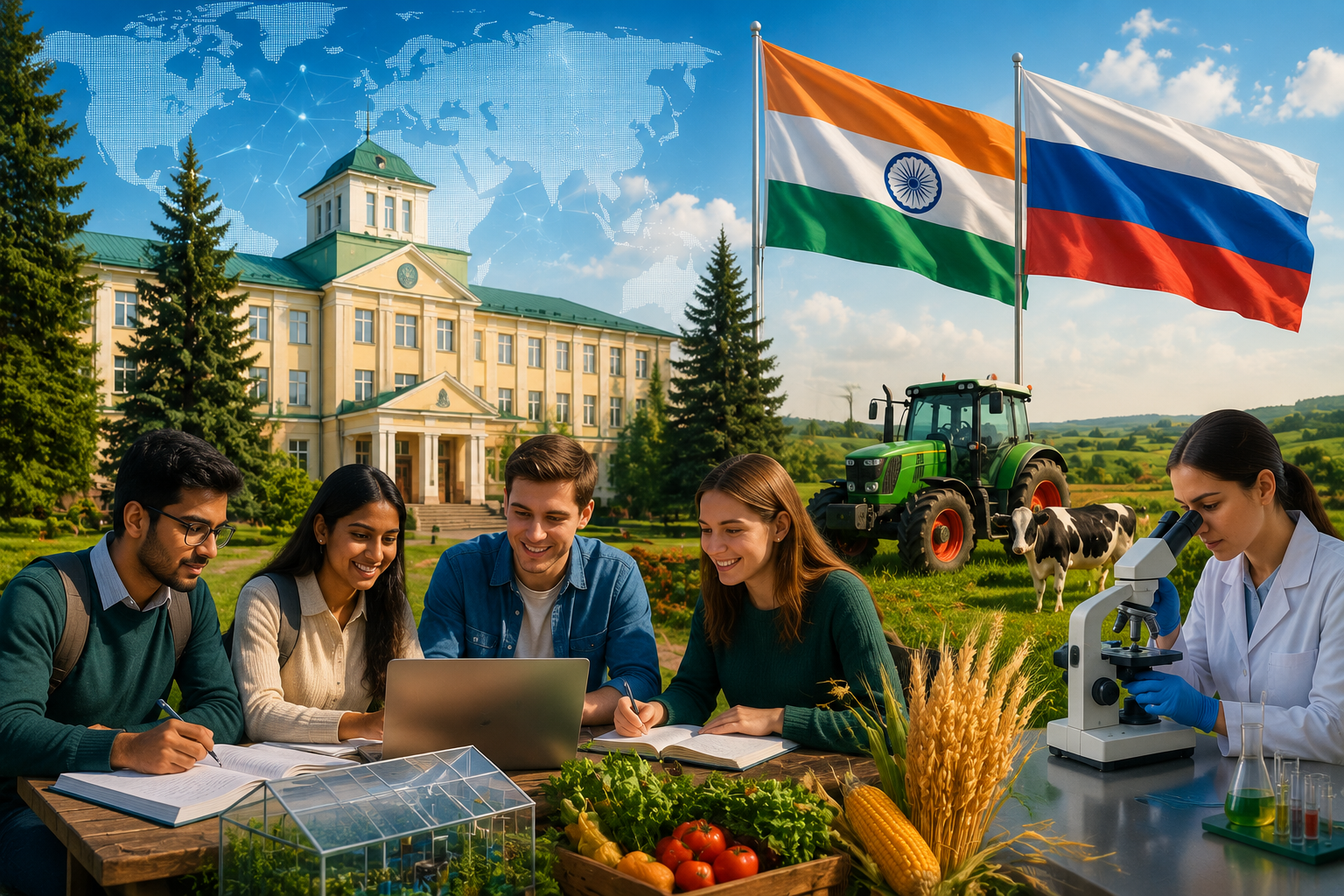
Russian university highlights agricultural education opportunities for Indian students amid growing global academic collaboration
The Irkutsk State Agrarian University named after A.A. Ezhevsky has showcased its academic offerings at the II Indo-Russian Education Summit 2026, inviting Indian students to explore higher education opportunities in agriculture, veterinary sciences, and agri-tech research in Russia.
The initiative reflects the broader strengthening of educational and research ties between India and Russia, particularly in areas linked to food security, sustainable agriculture, and rural development.
Historic Academic Institution with Strong Agricultural Legacy
Established in 1934 with a focused agri-education foundation
Founded on May 9, 1934, as the East Siberian Agricultural Institute, the university initially began with four core faculties:
- Agronomy
- Zootechnics
- Veterinary Medicine
- Agricultural Mechanisation
Over the decades, the institution has evolved into a multidisciplinary university with expanded academic departments, research capabilities, and international student engagement programs.
Today, the university operates as a modern higher education hub focusing on both theoretical and applied agricultural sciences.
Modern Curriculum Focused on Industry Requirements
Bridging academic learning with agro-industrial demand
The university has emphasized aligning its curriculum with the evolving needs of the global agro-industrial sector. The focus remains on developing job-ready professionals equipped with practical and research-oriented skills.
Key academic priorities include:
- Modern agricultural technology and innovation
- Sustainable farming and climate-resilient practices
- Veterinary sciences and livestock health management
- Agricultural engineering and mechanisation
- Food production efficiency and supply chain improvement
Faculty members at the institution are actively engaged in scientific research aimed at improving productivity and sustainability in agriculture-dependent economies.
International Collaboration and Student Mobility Push
India identified as key partner in global education strategy
At the Indo-Russian Education Summit 2026, the university highlighted India as an important partner in expanding international academic cooperation. The outreach is designed to attract Indian students seeking specialized education in agriculture and allied sciences.
The initiative aligns with growing global demand for:
- Skilled agricultural scientists
- Food security experts
- Agri-technology researchers
- Sustainable development professionals
For Indian students, such programs offer exposure to international research ecosystems and diversified agricultural practices suited to different climatic conditions.
Institutional Growth and Regional Expansion
Strengthening academic footprint across Siberian region
In 1979, the university expanded its presence by establishing a branch in Chita, which was later upgraded into the Transbaikal Agrarian Institute in 2000. This expansion reflects a long-term strategy to decentralize agricultural education and improve accessibility across Russia’s eastern regions.
The institution continues to strengthen its research infrastructure and international collaboration networks, supporting both domestic and foreign students.
Global Education Trend and Investment Perspective
Rising relevance of agri-education in global skill markets
From an investment and long-term workforce development perspective, agriculture-focused education is gaining renewed importance globally due to:
- Rising food security concerns
- Climate change adaptation needs
- Expansion of agri-tech startups
- Automation in farming systems
- Demand for sustainable supply chains
International academic collaborations such as this are expected to contribute to cross-border talent development, particularly in sectors linked to food production and rural innovation.
Outlook
Strengthening Indo-Russian academic corridor in specialized education
The participation of Irkutsk State Agrarian University at the Indo-Russian Education Summit 2026 signals a continued push toward deeper academic engagement between India and Russia.
As global agriculture becomes increasingly technology-driven, such partnerships are expected to play a key role in shaping the next generation of skilled professionals in sustainable farming, agri-research, and food systems management.