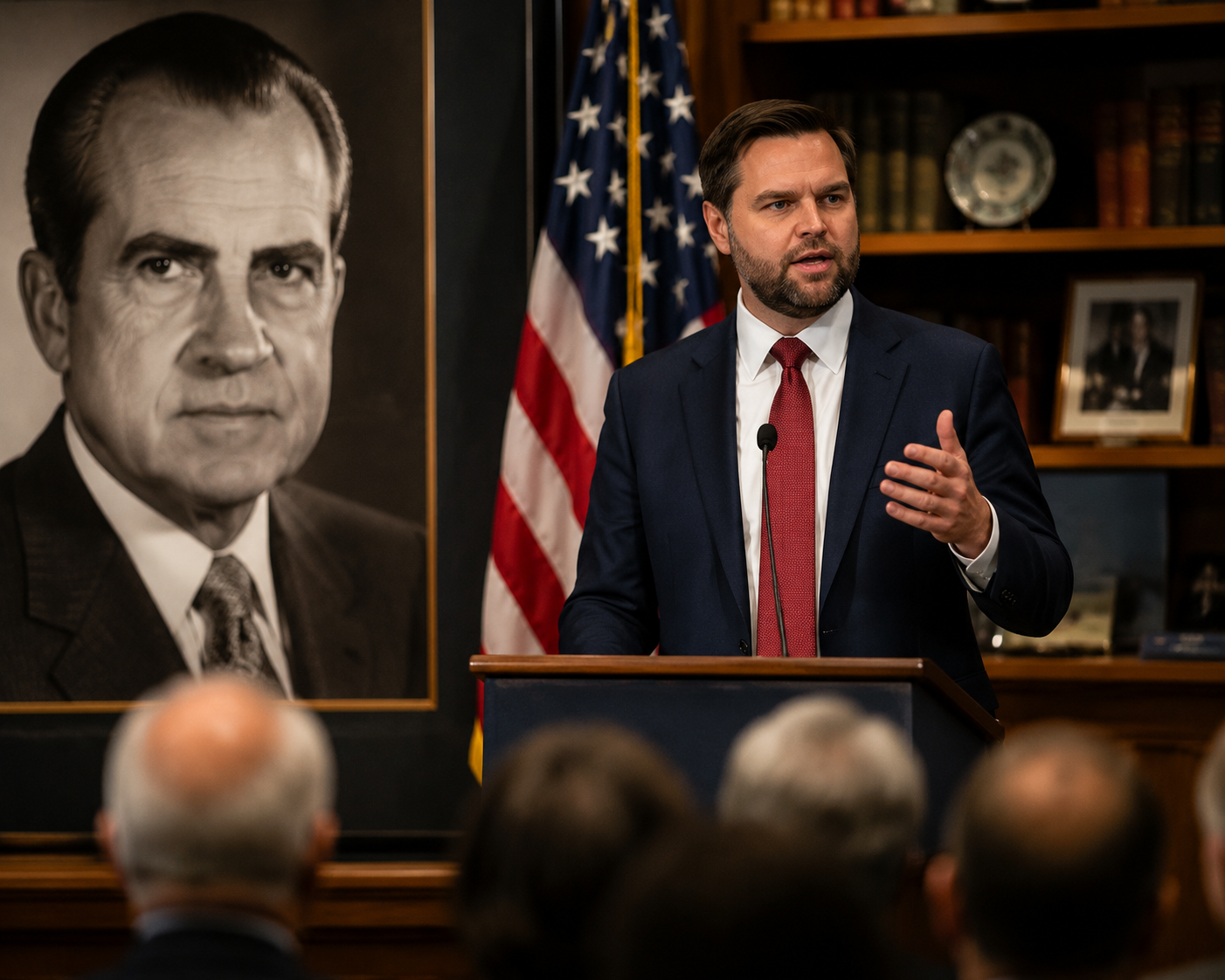
Remarks Made at Nixon Presidential Library Event
US Vice President JD Vance said that if the Watergate scandal happened in today’s media environment, it would likely be reduced to a brief news cycle rather than a defining political crisis.
Speaking at the Richard Nixon Presidential Library in California, Vance made the remarks during a discussion linked to his book promotion and reflections on American political history.
Watergate Would Not Have Ended a Presidency Today, Says Vance
Vance argued that the modern news ecosystem would significantly change how major political scandals unfold.
He suggested:
-
Watergate would be covered intensely but briefly
-
Media cycles today move faster than in the 1970s
-
Political consequences would not necessarily be as severe
The comments revive debate on how digital media has transformed political accountability and public attention spans.
Nixon’s Legacy Described as Undergoing “Renaissance”
During the event, Vance expressed admiration for former US President Richard Nixon, stating that Nixon’s legacy is experiencing renewed reassessment in political discourse.
Nixon, who resigned in 1974 following the Watergate scandal, has remained a complex figure in US political history, often debated for both policy achievements and the constitutional crisis that ended his presidency.
Comparison Between Nixon and Donald Trump
Vance also drew parallels between Nixon and former President Donald Trump, suggesting that both leaders faced sustained opposition from political and institutional forces.
He argued that:
-
Both administrations encountered intense media scrutiny
-
Institutional power structures influenced political narratives
-
Historical interpretation of both presidencies remains contested
The comparison is likely to add further fuel to ongoing US political polarization.
“Deep State” Reference Adds Political Controversy
Vance referred to what he described as “deep state” influence in both historical and modern political contexts.
He suggested that:
-
Institutional networks can shape political outcomes
-
Bureaucratic and media systems exert significant influence
-
Political conflicts often extend beyond elected leadership
The remarks align with long-standing debates in US politics over institutional power and transparency.
Personal Political Narrative and Future Ambitions
Vance also drew comparisons between his own career trajectory and Nixon’s, highlighting similarities such as:
-
Rise from outsider political status
-
Service in Senate and executive branch roles
-
Authorship of political works
-
Frequent media criticism
As a widely discussed figure in US politics, Vance is often viewed as a potential presidential contender in the 2028 election cycle.
Media Environment vs Historical Political Accountability
The comments highlight a broader debate about how modern media ecosystems affect political accountability.
Key issues include:
-
Speed of information dissemination in digital media
-
Shorter public attention cycles
-
Increased political polarization
-
Role of social media in shaping narratives
Experts argue that while visibility has increased, sustained accountability mechanisms remain complex.
Key Takeaway
JD Vance’s remarks at the Nixon Presidential Library reignite debate over how modern media would handle historic political scandals like Watergate. His comparisons between Nixon and Trump, along with references to institutional power structures, are expected to further intensify discussions on media influence and political accountability in the US.