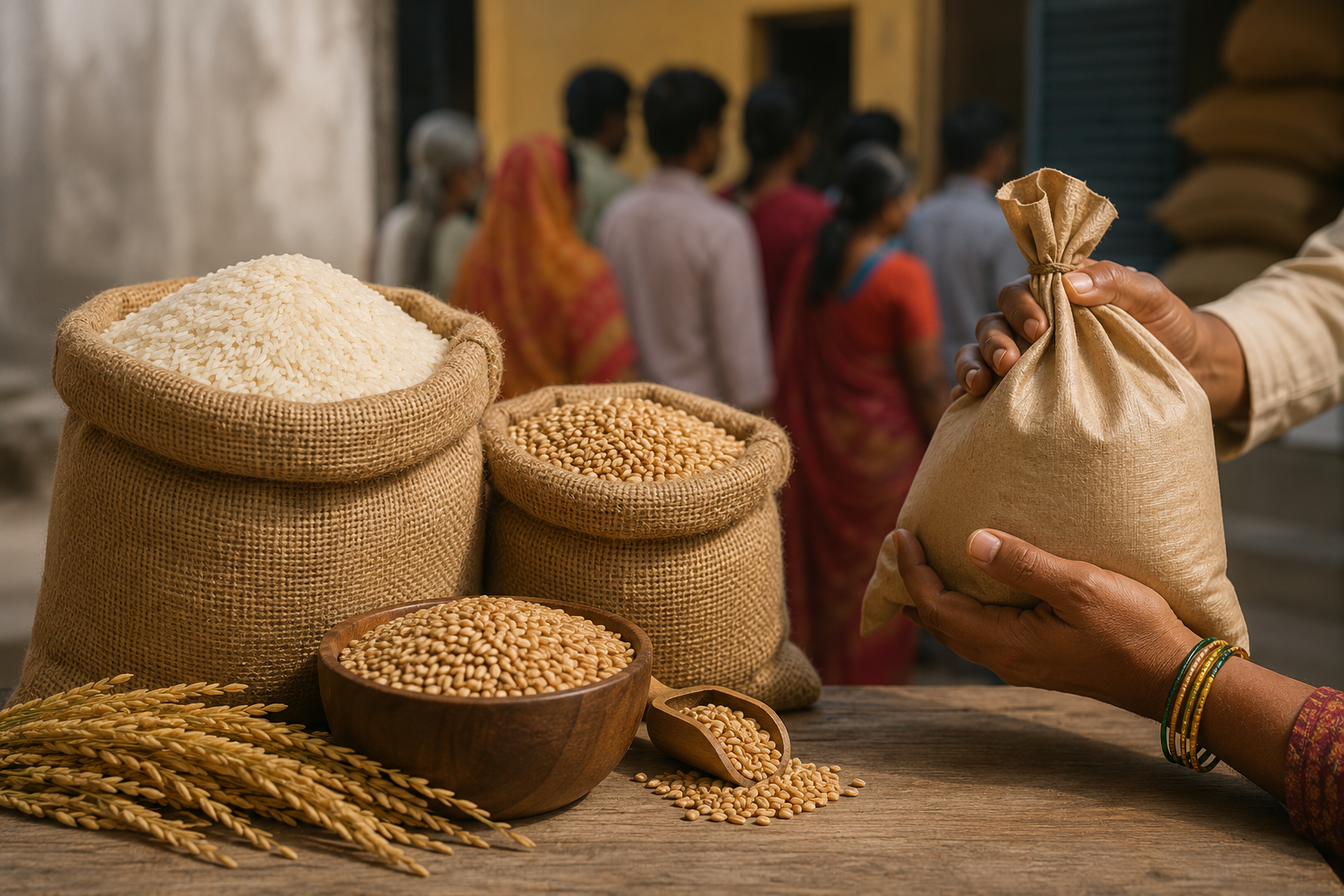
Proposed amendment to NFSA aims to ensure fairer distribution and strengthen food security for larger low-income households
The Central government is considering a major reform in the distribution of subsidised foodgrains under the Antyodaya Anna Yojana (AAY), a move that could significantly benefit larger families belonging to the economically weaker sections.
The Department of Food and Public Distribution has proposed amendments to the National Food Security Act (NFSA), 2013, to shift AAY beneficiaries from the existing household-based entitlement system to a per-person entitlement framework. The Food Ministry has invited comments from stakeholders and the public on the draft National Food Security (Amendment) Bill, 2026, till July 13.
Key Change: 7 kg Per Person Instead of Flat Household Allocation
Under the current provisions of the NFSA, every AAY household receives a fixed quota of 35 kilograms of foodgrains per month, irrespective of the number of family members. This means that a household comprising two members receives the same quantity as one with seven or eight members.
The proposed amendment seeks to provide 7 kilograms of foodgrains per person every month, subject to an overall ceiling of 35 kilograms per household. The change is expected to make the allocation process more equitable and need-based.
For instance, a family with five members would continue to receive 35 kg of foodgrains, while a household with three members would be entitled to 21 kg under the revised framework.
Larger Families Stand to Benefit
Policy experts believe that the proposed reform addresses a long-standing concern regarding inadequate foodgrain allocation for larger families. Many AAY beneficiaries, particularly in rural areas, often consist of extended families with six or more members, making the current fixed entitlement insufficient.
By linking ration allocation to family size, the government aims to ensure that food support reaches beneficiaries in proportion to their actual requirements.
The Antyodaya Anna Yojana covers the "poorest of the poor" households, including landless labourers, elderly individuals without social support, widows, disabled persons, and other vulnerable groups.
Implications for Food Subsidy and Welfare Delivery
The proposed change could lead to improved targeting of welfare benefits and reduce disparities in foodgrain distribution. However, successful implementation will require accurate and regularly updated beneficiary databases to ensure that family size details are correctly recorded.
Experts also point out that the amendment could have implications for the government's food subsidy expenditure, depending on the final beneficiary count and distribution mechanism.
Nevertheless, policymakers believe that a more inclusive and equitable distribution model could strengthen India's social safety net and improve nutritional security among vulnerable populations.
Strengthening India's Food Security Framework
The proposed amendment is part of the government's broader effort to modernise and strengthen the country's food security architecture. While Priority Households under NFSA currently receive 5 kg of foodgrains per person every month, the revised AAY structure seeks to provide additional support to the most disadvantaged sections of society.
The final contours of the amendment will emerge after the government reviews feedback received from stakeholders and the public. If approved, the reform could mark one of the most significant changes to India's public distribution system in recent years.
Outlook
The proposed shift from a fixed household quota to a per-person entitlement system reflects the government's attempt to make welfare schemes more responsive to demographic realities. If implemented effectively, the measure could improve food access for millions of vulnerable families while enhancing the efficiency of India's food distribution network.