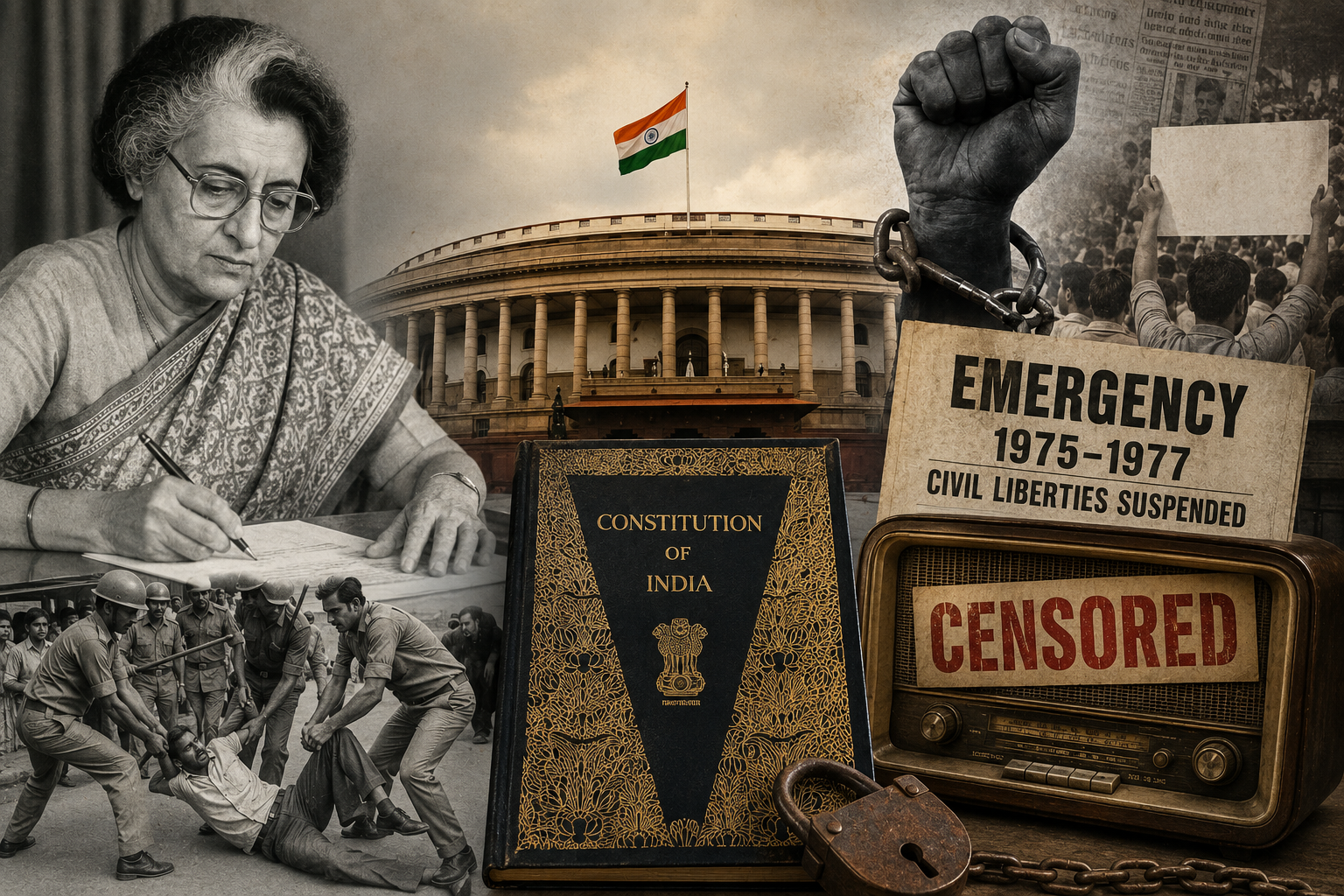
Prime Minister Pays Tribute to Defenders of Democracy, Reaffirms Commitment to Constitutional Values on 50th Anniversary of Emergency
Prime Minister Narendra Modi on Thursday described the Emergency imposed in 1975 as a "direct assault on the Indian Constitution" and one of the darkest chapters in the country's democratic history. Marking the anniversary of the Emergency, the Prime Minister said the period witnessed the suspension of civil liberties, restrictions on freedom of expression and significant pressure on democratic institutions.
In a series of posts on social media platform X, Modi paid tribute to political leaders, journalists, social workers and ordinary citizens who resisted the Emergency and defended democratic principles despite facing arrests, censorship and political repression.
The Union Government is observing June 25 as 'Samvidhan Hatya Diwas', a commemorative day introduced in 2025 to remember the proclamation of the Emergency and reaffirm the importance of safeguarding constitutional democracy.
PM Modi Reiterates Commitment to the Constitution
In his message, the Prime Minister said the Constitution represents the aspirations, rights and responsibilities of 140 crore Indians and remains the guiding force behind the country's democratic system.
He said India remains committed to the constitutional principles of:
-
Justice
-
Liberty
-
Equality
-
Fraternity
According to the Prime Minister, protecting democratic institutions and citizens' rights is essential for strengthening the nation's constitutional framework.
Tribute to Those Who Opposed the Emergency
Prime Minister Modi paid homage to individuals who opposed the Emergency despite facing imprisonment and restrictions.
He said the period demonstrated the courage of countless citizens who refused to remain silent and continued to uphold democratic ideals.
The Prime Minister stated that their sacrifices continue to inspire future generations to defend constitutional values and democratic freedoms.
What Was the Emergency?
The Emergency was proclaimed on June 25, 1975, under Article 352 of the Constitution of India, citing internal disturbances as the basis for the declaration.
It remained in force until March 21, 1977, making it one of the most significant constitutional events in independent India's history.
During this period:
-
Fundamental freedoms were curtailed.
-
Political opposition leaders were detained.
-
Press censorship was introduced.
-
Preventive detention laws were widely enforced.
-
Executive powers expanded significantly.
-
Administrative authority became increasingly centralized.
The Emergency continues to be studied extensively by constitutional scholars, historians and political analysts.
Impact on Democratic Institutions
The Emergency altered the functioning of several democratic institutions.
According to constitutional experts, the period witnessed:
-
Greater concentration of executive authority.
-
Reduced institutional checks and balances.
-
Restrictions on judicial review through constitutional amendments.
-
Curtailment of civil liberties.
-
Administrative control over media and public communication.
Several constitutional amendments enacted during the Emergency remain subjects of legal and historical discussion.
Press Freedom Faced Significant Restrictions
One of the defining features of the Emergency was the imposition of censorship on newspapers and media organizations.
Publications were required to comply with government directives before publishing news, while public criticism of government policies was significantly restricted.
The period has since become an important reference point in discussions concerning press freedom and freedom of expression in India.
Forced Sterilisation Campaign Remains One of the Most Controversial Chapters
The Emergency also witnessed the implementation of an aggressive family planning programme that included widespread sterilisation drives.
The campaign attracted considerable criticism and remains one of the most debated aspects of the Emergency period.
Historians continue to examine its social, political and administrative implications as part of India's democratic experience.
Emergency Ended After Historic General Elections
The Emergency formally concluded on March 21, 1977, following the general elections that resulted in a major political transition at the national level.
The elections are widely regarded as a landmark moment in India's democratic history, demonstrating the resilience of the electoral process and the ability of voters to bring about political change through constitutional means.
Following the Emergency, several legal and constitutional reforms were introduced to strengthen safeguards against the misuse of emergency provisions.
Why 'Samvidhan Hatya Diwas' Is Being Observed
The Government of India officially declared June 25 as 'Samvidhan Hatya Diwas' in 2025 through a Gazette notification.
According to the notification, the observance aims to:
-
Remember the events surrounding the Emergency.
-
Raise awareness about constitutional values.
-
Promote democratic accountability.
-
Highlight the importance of protecting civil liberties.
-
Encourage respect for democratic institutions.
The government has stated that the observance is intended to educate future generations about the significance of constitutional governance.
Constitutional Lessons from the Emergency
Legal scholars often describe the Emergency as a defining chapter in India's constitutional evolution.
The experience reinforced the importance of:
-
Independent judiciary.
-
Free and responsible media.
-
Parliamentary accountability.
-
Federal balance.
-
Fundamental rights.
-
Institutional autonomy.
-
Democratic participation.
Many constitutional safeguards that exist today were strengthened in response to lessons learned during the Emergency period.
Why the Anniversary Continues to Hold Significance
Even five decades later, the Emergency remains an important subject of political, legal and academic discussion.
The anniversary serves as an opportunity to reflect on:
-
The functioning of democratic institutions.
-
Protection of civil liberties.
-
Constitutional governance.
-
The balance between executive authority and individual rights.
-
The resilience of India's democratic system.
Different political parties and historians continue to interpret the period through varying historical and political perspectives, making it one of the most discussed chapters in modern Indian history.
Looking Ahead
As India commemorates the anniversary of the Emergency, discussions continue around the importance of preserving democratic institutions, constitutional safeguards and individual freedoms. Prime Minister Narendra Modi's remarks reaffirm the government's emphasis on protecting the values enshrined in the Constitution while paying tribute to those who opposed the Emergency.
More than 50 years after the proclamation of the Emergency, the period continues to serve as a significant reminder of the importance of constitutional accountability, institutional independence and democratic participation. Regardless of differing political interpretations, the Emergency remains a defining moment that shaped India's constitutional journey and continues to influence discussions on governance, civil liberties and the rule of law.