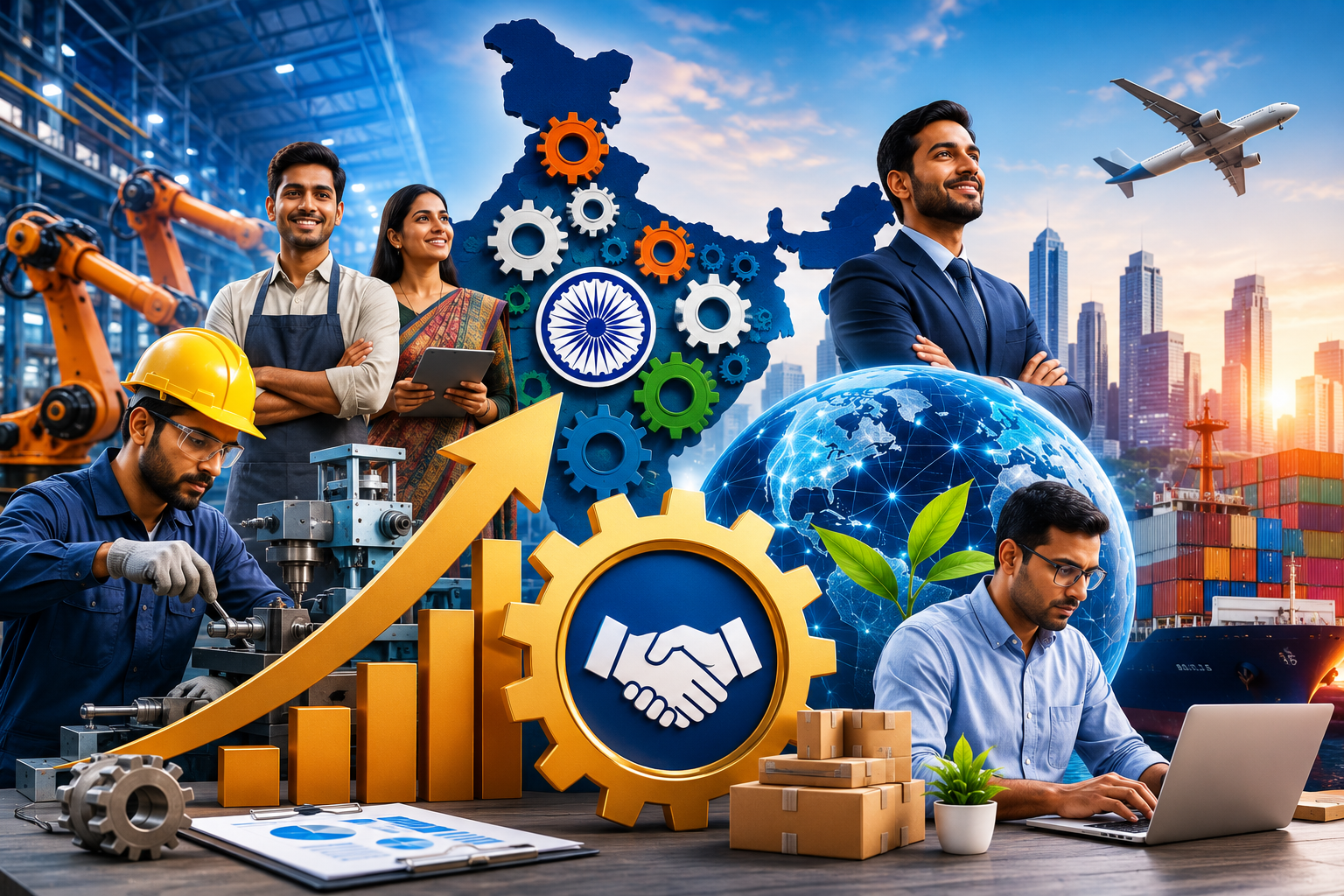
Industry Body Urges Quality-Driven Reforms to Integrate India's 7.47 Crore MSMEs into Global Value Chains and Accelerate Export-Led Growth
National Quality Mission aimed at strengthening the competitiveness of the country's 7.47 crore Micro, Small and Medium Enterprises (MSMEs). The organization believes that a nationwide focus on quality, productivity and innovation is essential for enabling Indian MSMEs to become integral players in global manufacturing and supply chains.
Despite being one of the largest MSME ecosystems in the world, India's contribution to global manufacturing and merchandise exports remains relatively modest. IFQM argues that the next phase of industrial growth should focus not merely on expanding the number of enterprises but on improving product quality, operational efficiency and international competitiveness.
The recommendation comes at a time when India is positioning itself as a global manufacturing hub under initiatives such as Make in India, Atmanirbhar Bharat, and the Production Linked Incentive (PLI) Scheme.
MSMEs Continue to Drive India's Economy
India's MSME sector remains one of the strongest pillars of the country's economic development.
According to the Economic Survey 2025–26, MSMEs contribute:
-
31.1% of India's Gross Domestic Product (GDP)
-
35.4% of total manufacturing output
-
48.58% of India's exports
Beyond these contributions, the sector supports millions of jobs, encourages entrepreneurship, promotes regional industrialization and plays a vital role in strengthening domestic supply chains.
With over 74.7 million registered enterprises, MSMEs are expected to remain central to India's ambition of becoming a $10 trillion economy in the coming years.
India's Global Manufacturing Share Remains Limited
Despite the massive domestic MSME base, India's presence in global manufacturing remains relatively small.
As highlighted by IFQM:
-
India accounted for only 2.9% of global manufacturing Gross Value Added (GVA) in 2024.
-
The country's share in global merchandise exports stood at just 1.8%.
This contrast highlights a critical challenge: while India has significant production capacity, many MSMEs have yet to become globally competitive in terms of quality, technology and productivity.
The organization believes this gap represents one of the biggest opportunities for India's manufacturing sector.
National Quality Mission Proposed
IFQM has proposed the creation of a National Quality Mission that would place quality improvement at the center of India's industrial strategy.
The proposed mission would focus on:
-
Raising manufacturing standards.
-
Promoting international quality certifications.
-
Improving productivity.
-
Enhancing product reliability.
-
Encouraging process excellence.
-
Supporting technology adoption.
-
Building globally competitive enterprises.
According to the organization, quality should become a national competitive advantage rather than merely a compliance requirement.
Why Quality Has Become a Global Business Requirement
In today's interconnected economy, multinational companies increasingly prefer suppliers capable of consistently meeting international quality standards.
Global buyers evaluate manufacturers based on:
-
Product consistency.
-
Quality certifications.
-
Delivery reliability.
-
Manufacturing capability.
-
Sustainability practices.
-
Process efficiency.
MSMEs that successfully adopt world-class quality systems are more likely to participate in international supply chains and secure long-term contracts with global corporations.
Integrating MSMEs into Global Value Chains
Global Value Chains (GVCs) have become the backbone of modern manufacturing.
Instead of producing complete products in one country, companies now source components from multiple countries based on efficiency and specialization.
IFQM believes Indian MSMEs can become important suppliers within these global networks by strengthening:
-
Product quality.
-
Supply chain reliability.
-
Digital manufacturing capabilities.
-
International compliance.
-
Operational efficiency.
-
Innovation capacity.
Greater participation in GVCs could significantly increase India's manufacturing exports and create new opportunities for small businesses.
Technology Will Be a Key Growth Driver
Industry experts believe digital transformation will play a crucial role in improving MSME competitiveness.
Technologies expected to reshape the sector include:
-
Artificial Intelligence (AI).
-
Industrial Automation.
-
Internet of Things (IoT).
-
Cloud Computing.
-
Robotics.
-
Advanced Quality Control Systems.
-
Digital Supply Chain Management.
Adoption of these technologies can improve productivity, reduce manufacturing defects and lower operating costs.
Government Schemes Supporting MSMEs
India has already introduced several policy initiatives to strengthen the MSME ecosystem.
Major programmes include:
-
Make in India.
-
Atmanirbhar Bharat.
-
Production Linked Incentive (PLI) Scheme.
-
PM Vishwakarma.
-
Credit Guarantee Fund Scheme.
-
Udyam Registration Portal.
-
National Logistics Policy.
-
Digital India.
IFQM believes that a dedicated National Quality Mission would complement these initiatives by improving the global competitiveness of Indian manufacturers.
Export Opportunities Continue to Expand
Global companies are actively diversifying manufacturing operations and supply chains.
This trend presents significant opportunities for Indian MSMEs across sectors such as:
-
Engineering goods.
-
Electronics.
-
Auto components.
-
Pharmaceuticals.
-
Chemicals.
-
Medical devices.
-
Textiles.
-
Food processing.
-
Industrial machinery.
Improved quality standards could help Indian businesses secure larger export orders and become preferred suppliers for multinational companies.
Challenges Facing India's MSMEs
While the sector has enormous growth potential, several structural challenges remain.
Key concerns include:
-
Limited access to finance.
-
Technology adoption gaps.
-
Low productivity.
-
Skill shortages.
-
Infrastructure constraints.
-
Compliance complexity.
-
Limited awareness of international standards.
Addressing these issues through targeted policy reforms could significantly improve the sector's long-term competitiveness.
Why International MSME Day Is Important
Observed annually on June 27, International MSME Day recognizes the critical contribution of small businesses to employment, innovation and inclusive economic development worldwide.
For India, the occasion serves as an opportunity to:
-
Promote entrepreneurship.
-
Encourage innovation.
-
Strengthen manufacturing.
-
Improve export competitiveness.
-
Enhance policy support for MSMEs.
Industry leaders believe the country's future manufacturing success will depend largely on empowering its MSMEs to compete globally.
What Investors and Businesses Should Watch
Businesses and investors should closely monitor:
-
Government response to IFQM's recommendations.
-
Future quality-focused policy initiatives.
-
Export promotion measures.
-
Technology adoption by MSMEs.
-
Manufacturing investment trends.
-
Global supply chain diversification.
-
Expansion of PLI-linked industries.
These developments could create significant opportunities across manufacturing, industrial automation, logistics and export-oriented sectors.
Outlook
The Indian Foundation for Quality Management's call for a National Quality Mission reflects a growing consensus that India's manufacturing ambitions must now shift from scale to global competitiveness. While the country's 7.47 crore MSMEs already contribute over 31% of GDP, 35% of manufacturing output, and nearly 49% of exports, their relatively small share in global manufacturing and merchandise exports highlights the need for quality-driven transformation.
As international companies continue to diversify supply chains, India has a unique opportunity to position its MSMEs as trusted global manufacturing partners. A nationwide focus on quality standards, digital transformation, technology adoption and productivity improvement could significantly enhance export competitiveness, attract greater foreign investment and strengthen India's position within global value chains. On the occasion of International MSME Day, IFQM's proposal underscores that sustained investment in quality may become one of the most important drivers of India's next phase of industrial and economic growth.