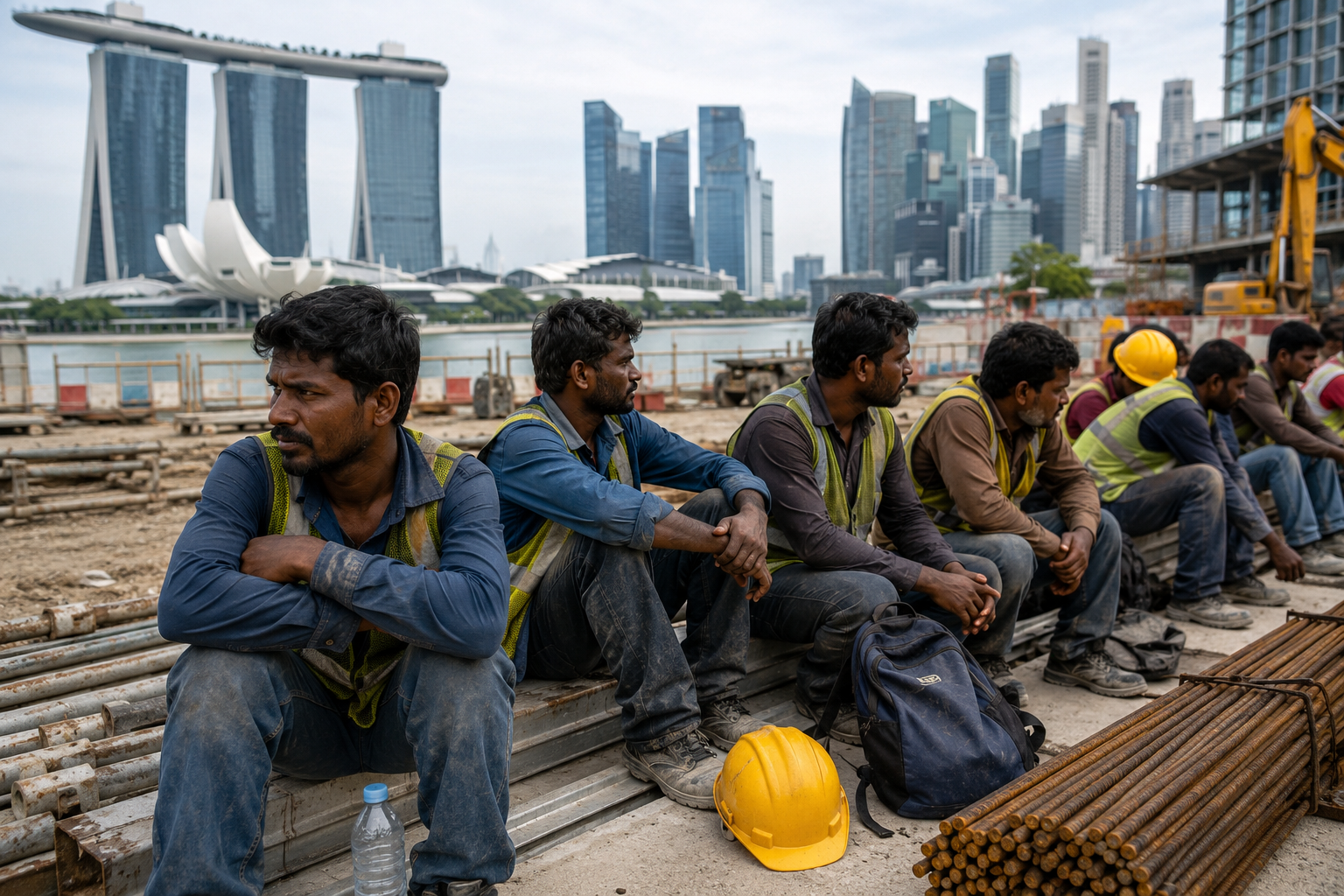
Hundreds of Indian and Bangladeshi Migrant Workers Left Without Wages and Accommodation as Singapore Agencies Launch Investigation
The High Commission of India in Singapore has stepped in to assist more than 400 migrant workers who were allegedly left without salaries and accommodation by three Singapore-based engineering companies. The diplomatic mission confirmed that it is working closely with Singapore's labour authorities and trade unions to ensure the affected workers receive immediate assistance while investigations into the companies continue.
The workers, mainly from India and Bangladesh, were employed by SK Industries, KPA Engineering, and VVR Plant Engineering. According to reports, the companies allegedly failed to pay wages for several months before abandoning the workers, leaving many without financial support or housing.
The case has drawn significant attention in Singapore and India, highlighting the challenges faced by migrant workers and the importance of strong labour protection mechanisms.
Indian High Commission Coordinates Relief Efforts
In a statement issued on Wednesday evening, the High Commission of India said it is in regular contact with the affected Indian workers and is coordinating with Singapore's Ministry of Manpower (MOM) and the National Trades Union Congress (NTUC).
The mission stated that assistance is being provided to ensure the safety and welfare of Indian nationals affected by the situation.
Support efforts currently include:
-
Coordination with Singaporean authorities.
-
Consular assistance for Indian workers.
-
Temporary accommodation support.
-
Access to food and basic necessities.
-
Guidance regarding wage claims and legal procedures.
The High Commission also assured that it will continue monitoring developments until the matter is resolved.
More Than 400 Workers Left Without Wages
According to local reports, more than 400 migrant workers from India and Bangladesh have been impacted by the alleged abandonment.
Many workers reportedly remained unpaid for several months before losing company-provided accommodation.
The affected workers are now dealing with several immediate challenges, including:
-
Outstanding salary payments.
-
Loss of employer-provided housing.
-
Daily living expenses.
-
Employment uncertainty.
-
Visa and work permit concerns.
Singapore's labour agencies have initiated emergency support measures while investigations into the companies continue.
Common Director Identified Across Three Companies
According to a report by The Straits Times, a common director has been identified across all three companies involved in the case.
The individual has been named as Ramu Palani Velu, an Indian national.
Authorities are investigating the management and financial affairs of the companies to determine whether employment regulations were violated.
At present, the identification of the director forms part of the ongoing investigation, and authorities have not announced the outcome of any legal proceedings.
Companies Under Investigation
The three companies at the centre of the case are:
-
SK Industries.
-
KPA Engineering.
-
VVR Plant Engineering.
These firms are engaged in engineering and industrial services, sectors that employ a substantial number of migrant workers in Singapore.
Authorities are examining several aspects of their operations, including:
-
Payment of employee salaries.
-
Compliance with labour regulations.
-
Worker accommodation responsibilities.
-
Financial management.
-
Corporate governance practices.
The findings of the investigation will determine whether further enforcement action is warranted under Singapore's employment laws.
Singapore's Labour Laws Offer Protection to Migrant Workers
Singapore has a comprehensive legal framework governing the employment of foreign workers.
Employers are generally required to:
-
Pay wages on time.
-
Provide approved accommodation where applicable.
-
Maintain valid employment permits.
-
Ensure worker welfare.
-
Comply with Ministry of Manpower regulations.
Failure to fulfil these obligations can result in penalties, restrictions on hiring foreign workers, licence suspensions or legal action.
The Ministry of Manpower regularly works with labour unions and embassies to support workers affected by employer disputes.
NTUC and Ministry of Manpower Provide Immediate Assistance
Singapore's National Trades Union Congress (NTUC) and the Ministry of Manpower have been actively assisting the affected workers.
The relief measures include:
-
Temporary housing arrangements.
-
Food assistance.
-
Medical support where necessary.
-
Guidance on employment rights.
-
Assistance in recovering unpaid wages.
-
Help with securing alternative employment opportunities.
Such interventions are designed to minimise hardship while legal and administrative processes are underway.
Importance of Overseas Worker Protection
India is one of the world's largest suppliers of skilled and semi-skilled workers to international labour markets.
Millions of Indian professionals and workers are employed across sectors such as:
-
Construction.
-
Engineering.
-
Manufacturing.
-
Marine services.
-
Hospitality.
-
Healthcare.
-
Information technology.
Indian diplomatic missions regularly coordinate with host governments to protect the rights and welfare of Indian citizens working abroad.
The Ministry of External Affairs also provides emergency assistance, legal support and repatriation assistance in cases involving labour disputes or employer-related issues.
Corporate Governance and Employer Accountability Under Spotlight
The incident has once again highlighted the importance of responsible corporate governance and financial discipline among employers.
Industry observers note that businesses employing migrant workers must maintain:
-
Financial transparency.
-
Timely salary payments.
-
Compliance with labour laws.
-
Adequate employee accommodation.
-
Ethical employment practices.
-
Strong internal governance systems.
Failure to uphold these standards can damage corporate reputation while creating significant social and economic consequences for workers and their families.
Economic Importance of Migrant Workers
Migrant workers play a critical role in supporting Singapore's economy, particularly in sectors such as construction, infrastructure, engineering and industrial services.
Their contributions are essential for:
-
Large infrastructure projects.
-
Industrial manufacturing.
-
Urban development.
-
Maintenance services.
-
Shipbuilding and marine industries.
Protecting migrant workers' rights not only supports social welfare but also strengthens confidence in Singapore's labour market and business environment.
What Happens Next?
Authorities are expected to continue their investigations into the financial and operational affairs of the three companies.
Key developments likely to be monitored include:
-
Recovery of unpaid wages.
-
Employer accountability under labour laws.
-
Long-term accommodation arrangements.
-
Alternative employment opportunities.
-
Status of work permits.
-
Possible legal proceedings.
-
Continued assistance from the Indian High Commission and Singaporean agencies.
The outcome of the investigation will determine the next course of action for both the companies and the affected workers.
Outlook
The case involving SK Industries, KPA Engineering and VVR Plant Engineering has brought renewed attention to the importance of safeguarding migrant workers' rights and ensuring employer accountability. With more than 400 Indian and Bangladeshi workers reportedly left without wages and accommodation, coordinated efforts by the High Commission of India, Singapore's Ministry of Manpower, and the National Trades Union Congress have become vital in providing immediate relief.
As investigations progress, authorities will focus on ensuring unpaid wages are addressed, affected workers receive necessary support, and any violations of employment regulations are dealt with under Singapore's legal framework. The incident also serves as a reminder of the importance of robust labour governance, ethical business practices and strong international cooperation in protecting overseas workers.