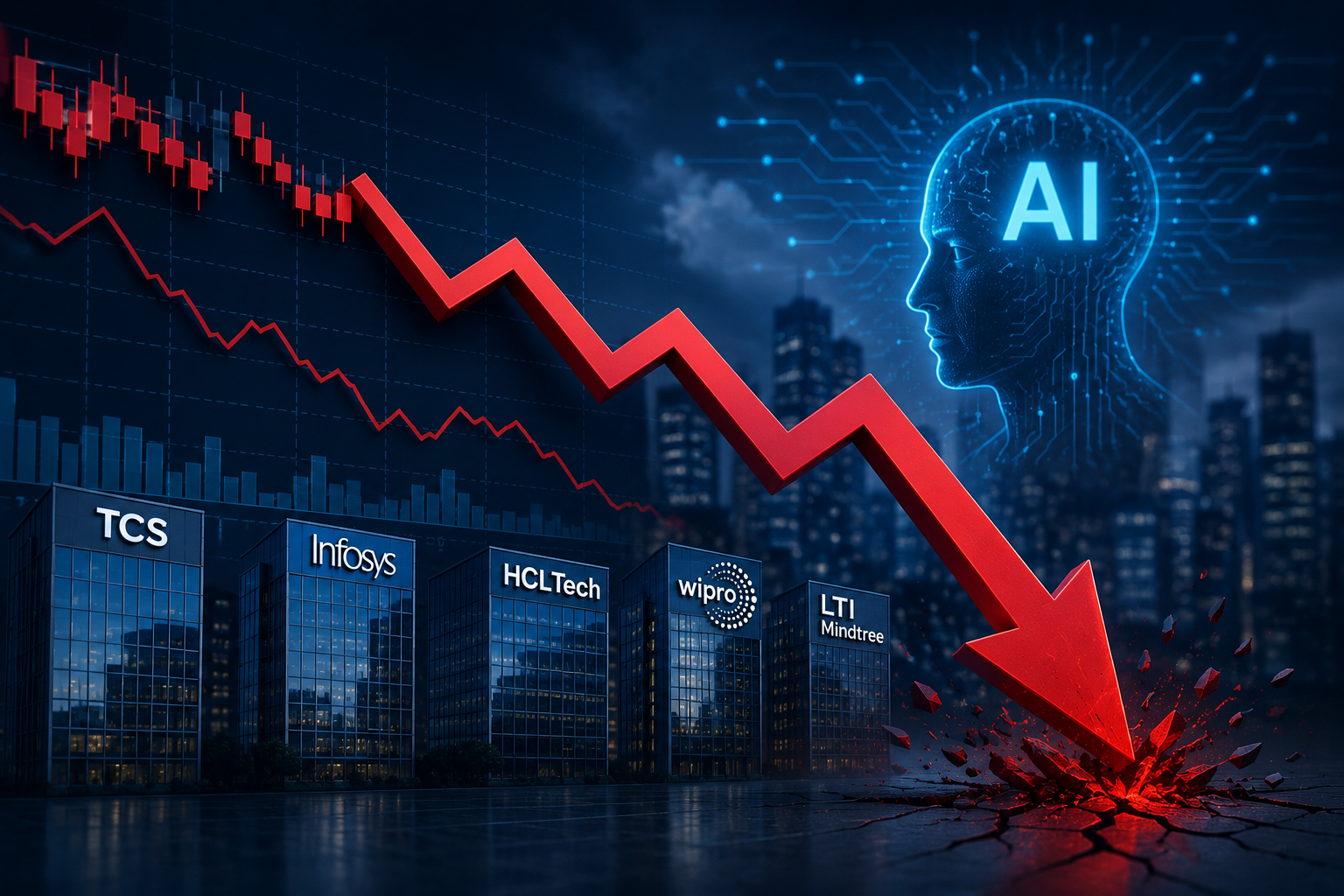
Nifty IT Index Loses Nearly One-Third of Its Value as Investors Reassess Growth Prospects for India's Technology Giants
India's information technology sector, long regarded as one of the pillars of the country's corporate success story, is facing one of its toughest market corrections in recent years. Concerns surrounding artificial intelligence, slowing global technology spending, and uncertainty over future outsourcing demand have triggered a sharp sell-off across frontline IT stocks.
Several leading technology companies have witnessed declines of up to 36 per cent from their February 2026 highs, raising concerns among investors about earnings visibility and long-term business models. While some market participants see the correction as an attractive entry opportunity, others believe the sector could face further challenges as AI reshapes the global technology landscape.
Nifty IT Suffers Sharpest Correction in Years
The Nifty IT Index has fallen nearly 30 per cent from its February peak of 40,301 to around 28,400 levels, significantly underperforming the broader market.
The decline comes as investors increasingly question whether traditional IT services companies can maintain historical growth rates in an environment where artificial intelligence is automating tasks that were previously outsourced to technology service providers.
Market experts note that the current correction reflects not only concerns about earnings growth but also a reassessment of valuation multiples that technology companies enjoyed during the digital transformation boom.
The sharp fall has erased substantial market capitalization across the sector and has turned investor sentiment cautious despite India's strong position in the global IT services industry.
AI Revolution Changes Industry Dynamics
Artificial intelligence has emerged as the biggest talking point for the technology sector in 2026.
While global enterprises continue to increase spending on AI-driven solutions, traditional IT services revenue growth has remained relatively modest. Analysts believe businesses are reallocating technology budgets toward automation, machine learning, and generative AI initiatives rather than conventional outsourcing contracts.
This shift has created uncertainty for companies that have historically relied on large-scale workforce-based service models.
At the same time, industry leaders argue that AI should be viewed as an opportunity rather than a threat. Technology firms are investing heavily in AI platforms, cloud solutions, cybersecurity, and digital transformation services in an effort to capture the next wave of enterprise spending.
The challenge lies in the transition period, where revenue growth from new AI opportunities has yet to fully offset concerns regarding traditional service lines.
HCL Technologies Faces the Steepest Decline
Among large-cap IT companies, HCL Technologies has emerged as the biggest loser during the recent correction.
The stock has declined approximately 36 per cent from its February highs, making it one of the worst-performing constituents of the Nifty IT Index.
Technical analysts point out that the stock remains in a clear downtrend, with lower highs and lower lows continuing to dominate price action. The stock is currently testing an important support zone, and market participants are closely watching whether buyers step in at current levels.
A sustained move below key support could trigger another round of selling pressure, while stability above support levels may encourage bargain hunters to return.
Infosys at a Critical Crossroads
Infosys, India's second-largest IT services company, is also facing considerable pressure.
The stock recently slipped below a major technical support zone, highlighting weak investor sentiment. However, analysts note that selling momentum has not accelerated significantly, suggesting that investors are waiting for additional triggers before taking aggressive positions.
Market participants are closely monitoring support levels around recent lows. A breakdown below these levels could result in further downside, while stabilization could lead to a period of consolidation before the next directional move.
Despite near-term concerns, Infosys continues to maintain a strong global client base, healthy balance sheet, and leadership position in digital transformation services.
TCS Remains Under Pressure Despite Strong Fundamentals
India's largest IT company, Tata Consultancy Services (TCS), has also witnessed a significant correction from its peak levels.
The stock remains in a prolonged downtrend and has consistently broken through multiple support levels over recent months. Technical indicators suggest that the stock is approaching an important long-term support zone that could attract value-oriented investors.
Fundamentally, TCS remains one of the strongest companies in the sector, supported by robust cash generation, diversified global operations, and a strong order pipeline. However, concerns over future revenue growth have continued to weigh on market sentiment.
Investors are increasingly looking for evidence that AI-related investments can generate meaningful earnings growth before assigning higher valuations to the stock.
Global Economic Uncertainty Adds to Pressure
Beyond AI-related concerns, the IT sector is also facing broader macroeconomic challenges.
Slower economic growth in key markets such as the United States and Europe has prompted businesses to review technology budgets and delay discretionary spending decisions. Since a significant portion of revenue for Indian IT firms originates from overseas markets, global economic conditions remain a crucial factor influencing sector performance.
Currency fluctuations, geopolitical tensions, and evolving regulatory frameworks are additional variables that investors are monitoring closely.
Long-Term Opportunities Still Intact
Despite the ongoing correction, many analysts remain optimistic about the long-term prospects of India's technology sector.
Digital transformation remains a multi-year global trend, and demand for cloud computing, cybersecurity, data analytics, artificial intelligence, and automation services is expected to grow substantially over the coming decade.
Indian IT companies possess significant advantages, including skilled talent pools, global delivery capabilities, established client relationships, and strong balance sheets. These strengths could help them adapt successfully to the changing technology landscape.
The current market correction may ultimately separate companies that successfully embrace AI-driven transformation from those that struggle to evolve.