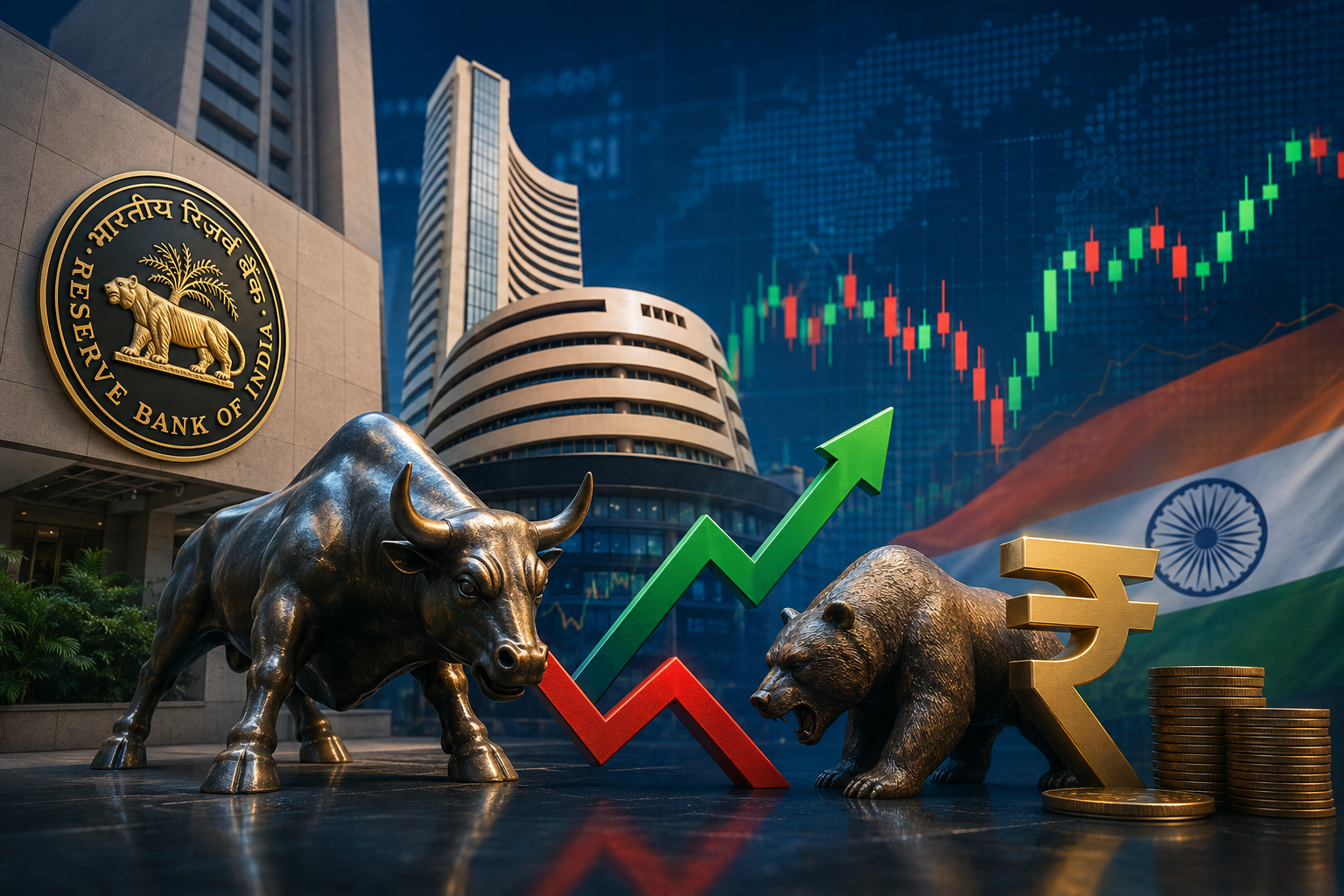
Sensex Drops Over 200 Points While Nifty Tests 23,300 Amid Policy Review and Global Uncertainty
Indian equity markets witnessed a volatile trading session on Friday as investors reacted to the latest monetary policy announcement by the Reserve Bank of India (RBI). While the central bank maintained the status quo on interest rates, market participants remained cautious due to ongoing geopolitical tensions, elevated crude oil prices, and concerns over global economic growth.
The benchmark Sensex declined more than 200 points during the session, while the Nifty 50 briefly tested the 23,300 level before recovering some losses. The Indian rupee, however, strengthened against the US dollar, reflecting improved sentiment following a series of policy measures aimed at attracting foreign capital.
RBI Maintains Repo Rate at 5.25%
The RBI's Monetary Policy Committee (MPC) unanimously decided to keep the policy repo rate unchanged at 5.25 percent and retain its neutral stance. The central bank emphasized the need to balance economic growth with inflation management amid increasing global uncertainties.
RBI Governor Sanjay Malhotra noted that while domestic economic fundamentals remain resilient, external risks continue to pose challenges. Rising geopolitical tensions in West Asia, volatile energy prices, and potential disruptions to global supply chains remain key concerns for policymakers.
The central bank also revised its GDP growth forecast for FY27 to 6.6 percent from the earlier estimate of 6.9 percent. At the same time, it increased the inflation forecast to approximately 5.1 percent, citing upside risks from commodity prices and external factors.
Government Announces Major Boost for Foreign Investors
One of the most significant developments accompanying the policy announcement was the government's decision to exempt foreign investors from capital gains tax on investments in government securities. The move is expected to improve the attractiveness of India's debt market and encourage greater foreign participation.
Authorities also announced several measures to support foreign capital inflows, including expanding the universe of securities available under the Fully Accessible Route (FAR) and increasing investment limits for Non-Resident Indians (NRIs) and Overseas Citizens of India (OCIs).
Market experts believe these reforms could help stabilize the rupee, enhance liquidity in financial markets, and strengthen investor confidence over the medium term.
Sectoral Performance Remains Mixed
Rate-sensitive sectors reacted positively to the RBI's decision. Banking, financial services, and real estate stocks outperformed the broader market as investors welcomed the continuation of stable borrowing costs.
On the other hand, metal, information technology, and FMCG stocks faced selling pressure. Concerns regarding global demand, commodity price fluctuations, and export-related uncertainties weighed on sentiment within these sectors.
Broader market indices also traded lower, with both mid-cap and small-cap segments experiencing moderate declines during the session.
Defence Stocks Continue Strong Momentum
Defence-related companies emerged among the top gainers in the market. Several stocks within the sector rallied sharply after investors responded positively to expectations of increased government spending on defence modernization and indigenous manufacturing initiatives.
Market participants remain optimistic about the sector's long-term growth prospects, supported by rising defence budgets, export opportunities, and continued policy support under the government's self-reliance initiatives.
Corporate Developments Support Market Activity
Among individual companies, Coal India announced measures aimed at improving domestic coal availability and reducing import dependence. The company plans to offer record volumes through linkage auctions to support industrial demand and ensure energy security.
Meanwhile, Maruti Suzuki India revealed plans to invest approximately ₹925 crore in green energy projects by FY31. The investment will support the company's sustainability goals and strengthen its commitment to cleaner mobility solutions and renewable energy adoption.
Bajaj Electricals also attracted investor attention after announcing its entry into the cables segment under its lighting solutions business, expanding its product portfolio and growth opportunities.
Outlook: Stability with Selective Opportunities
While the RBI's policy decision was largely in line with market expectations, investors are expected to remain focused on inflation trends, crude oil prices, foreign fund flows, and global geopolitical developments.
Analysts believe the combination of policy stability and measures to attract foreign capital provides a supportive backdrop for Indian markets. However, near-term volatility could persist due to external risks and changing global economic conditions.
For long-term investors, sectors linked to domestic consumption, financial services, infrastructure, defence, and green energy continue to offer promising opportunities as India's economic growth story remains intact despite global headwinds.