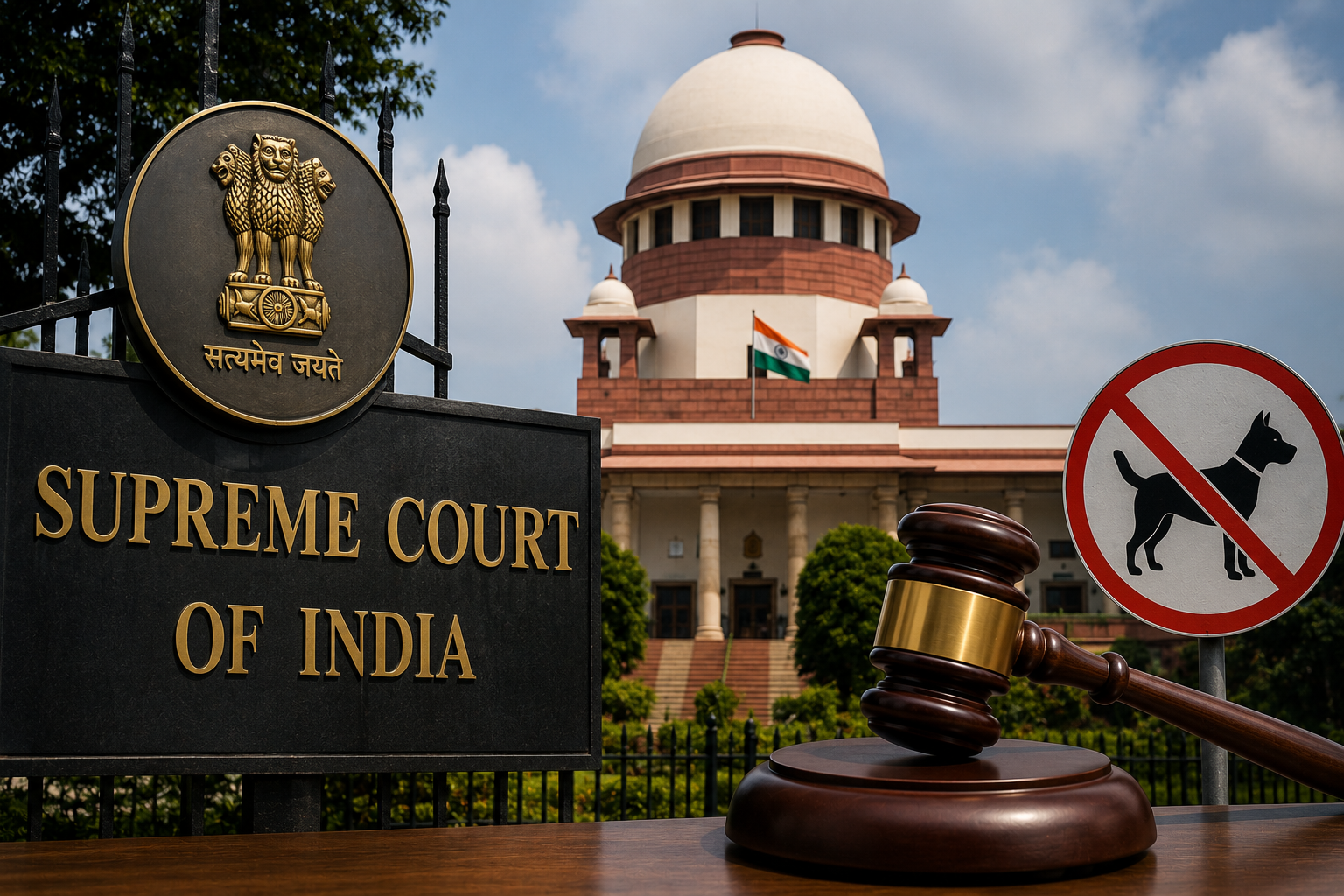
Apex court refuses urgent plea over Punjab CM’s comments, reiterates strict compliance of stray dog management guidelines
The Supreme Court of India on Monday declined to entertain an urgent plea related to remarks allegedly made by Punjab Chief Minister Bhagwant Mann on the court’s recent stray dogs verdict, directing the petitioner to instead approach the Punjab and Haryana High Court.
The matter arose after allegations that the Punjab chief minister had interpreted the Supreme Court’s May 19 order as granting authorities a “free hand” to kill stray dogs. The apex court, however, made it clear that it would not reopen or reconsider its judgment merely on the basis of political statements.
Supreme Court Refuses Immediate Intervention
A bench comprising Justices Vikram Nath and Sandeep Mehta heard the matter after it was urgently mentioned before the court.
The petitioner’s counsel argued that statements allegedly made by Punjab Chief Minister Bhagwant Mann following the court’s verdict had created confusion and led to fears of stray dogs being targeted aggressively.
Responding to the plea, the bench observed that judicial orders cannot be modified or reconsidered solely because a public representative makes a statement regarding them.
“If a chief minister makes a statement, does that mean we have to change our order?” the bench remarked during the proceedings.
Court Directs Petitioner to Punjab and Haryana High Court
The Supreme Court advised the petitioner to approach the Punjab and Haryana High Court for any grievance related to the implementation or interpretation of the order in Punjab.
The bench clarified that the High Court was the appropriate forum to examine whether any action by local authorities violated the Supreme Court’s directions or legal safeguards related to stray animal management.
The apex court also reiterated that all authorities are required to strictly comply with the directions issued in the stray dogs judgment.
Bhagwant Mann’s Social Media Remarks Trigger Controversy
The controversy erupted after Bhagwant Mann reportedly posted a message on social media platform X in Punjabi, thanking the Supreme Court and announcing that Punjab would launch a large-scale campaign against stray and dangerous dogs.
According to reports, the chief minister’s statement suggested that action would be taken against stray dogs posing a threat to children and pedestrians.
The remarks quickly sparked criticism from animal welfare activists and legal observers, who argued that the Supreme Court’s ruling should not be interpreted as unrestricted permission for large-scale killing of stray animals.
Landmark Supreme Court Verdict on Stray Dogs
The case stems from a major verdict delivered by the Supreme Court of India on May 19 regarding public safety and stray dog management.
In a significant ruling, the court allowed euthanasia of rabid, incurably ill, dangerous and highly aggressive stray dogs in order to protect human lives and public safety.
The apex court observed that the constitutional right to life includes the right of citizens to move freely and safely without fear of attacks from dangerous animals.
Human Safety Given Constitutional Priority
In one of its strongest observations on the issue, the Supreme Court stated that when the protection of human life is weighed against the welfare of animals, the constitutional balance must tilt in favour of safeguarding people.
The court acknowledged increasing incidents of stray dog attacks across various parts of the country, particularly involving children, elderly citizens and pedestrians.
The judgment reflected growing judicial concern over the inability of civic authorities to effectively manage stray animal populations while ensuring public safety.
States Asked to Improve Animal Management Infrastructure
While permitting euthanasia in specific cases, the Supreme Court also directed all states and Union Territories to strengthen infrastructure for handling stray dogs and other animals.
The court called for improved:
- Animal shelters
- Sterilisation programmes
- Vaccination drives
- Emergency response systems
- Municipal monitoring mechanisms
The apex court further instructed all High Courts to register suo motu proceedings to monitor compliance with earlier directions issued in August and November 2025 concerning stray animal management.
National Debate Over Stray Dogs Intensifies
The issue has once again reignited debate across the country over balancing animal welfare concerns with rising public safety issues caused by aggressive stray dogs.
Animal rights organisations continue to advocate humane population control measures, while many citizens and local authorities have demanded stricter action after several fatal and serious dog attack incidents in different states.
Policy experts believe the Supreme Court’s ruling could significantly influence future municipal policies, animal welfare regulations and urban safety frameworks across India.
Legal and Policy Implications Remain Significant
Legal experts say the latest developments underline the growing complexity of balancing constitutional rights, public safety and animal welfare concerns in densely populated urban regions.
The Punjab and Haryana High Court is now expected to become the next key legal forum where questions related to the interpretation and implementation of the Supreme Court’s ruling may be examined in greater detail.