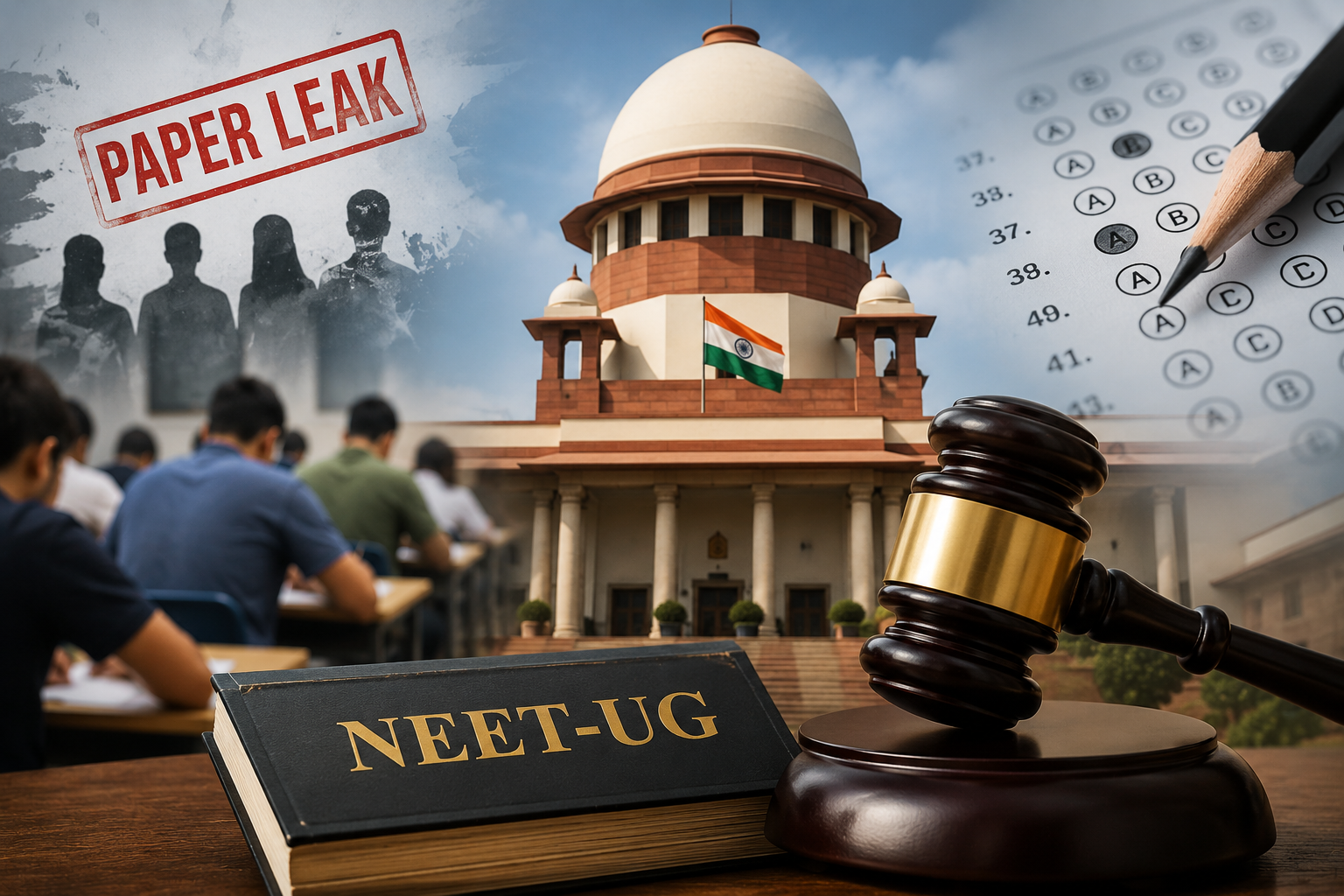
Top court seeks detailed response from Centre, NTA and CBI as demands grow for independent examination authority and stronger safeguards
The Supreme Court on Monday came down heavily on the National Testing Agency over the recurring NEET-UG paper leak controversy, observing that the agency appeared to have failed to learn from earlier incidents despite previous judicial intervention and reform recommendations.
The sharp remarks came during the hearing of multiple petitions seeking a major overhaul of the medical entrance examination system following allegations of another NEET-UG paper leak this year.
A bench comprising Justices PS Narasimha and Alok Aradhe issued notices to the Centre, the NTA and the Central Bureau of Investigation, directing them to respond to concerns raised regarding the integrity and functioning of the examination process.
“NTA Has Not Learnt Lessons,” Says Supreme Court
During the proceedings, the Supreme Court expressed dissatisfaction with the handling of examination security despite earlier controversies surrounding NEET examinations.
The bench observed that the issue had previously reached the apex court, following which committees were constituted and recommendations were accepted to strengthen examination procedures and prevent leaks.
“It is sad that they have not learnt their lessons,” the court remarked, while asking the NTA to submit a detailed affidavit explaining the steps taken to implement earlier reform measures and compliance recommendations.
The court directed the testing agency to file its response by Thursday.
Court Seeks Details on Reform Measures
The Supreme Court also asked the Centre-appointed committee led by former Indian Space Research Organisation chief K Radhakrishnan to provide details about the implementation of the reforms suggested earlier to improve transparency and security in national-level examinations.
The committee had previously recommended structural changes, technological safeguards and enhanced monitoring mechanisms aimed at preventing malpractice and improving examination integrity.
The court indicated that it would closely review whether those recommendations were actually implemented or remained only on paper.
Medical Body Demands Replacement of NTA
The petition filed by the Federation of All India Medical Association (FAIMA) sought direct restructuring or replacement of the NTA with a more robust, autonomous and transparent examination authority.
The medical association argued that repeated paper leaks represent a “direct assault” on the rights and future of more than 22 lakh medical aspirants who appear for the highly competitive NEET-UG examination every year.
According to the petition, the credibility of the examination system has suffered severe damage due to repeated allegations of irregularities and security lapses.
Demand for High-Powered Monitoring Committee
FAIMA also requested the Supreme Court to appoint a temporary high-powered monitoring committee until a new examination authority is formally established.
The proposed committee, according to the plea, should include:
- A retired Supreme Court judge as chairperson
- A cybersecurity expert
- A forensic science specialist
The petitioners argued that such a committee would help ensure greater transparency and prevent further paper leaks during any future re-examination process.
NEET-UG Cancellation Sparks Nationwide Concern
The undergraduate-level National Eligibility cum Entrance Test (NEET-UG), conducted on May 3 by the NTA for admission into medical courses across India, was cancelled on May 12 following widespread allegations of paper leaks and malpractice.
The incident triggered nationwide protests, political reactions and legal challenges as students and parents questioned the fairness of the examination process.
The investigation into the alleged leak is currently being handled by the Central Bureau of Investigation, which is probing possible organised networks and examination-related irregularities.
Students Face Anxiety and Uncertainty
The controversy has created significant uncertainty for lakhs of students preparing for medical admissions. Many aspirants have expressed frustration over repeated disruptions, mental stress and concerns regarding merit-based selection.
Education experts say recurring leaks not only damage institutional credibility but also undermine confidence in competitive examinations that determine the future careers of students.
The repeated controversies have also reignited debates around the need for technological upgrades, decentralised security systems and stricter accountability mechanisms within national testing agencies.
Bigger Questions Over India’s Examination System
The latest controversy has once again brought national attention to the challenges faced by India’s large-scale examination ecosystem, which conducts entrance tests for millions of students every year.
Experts believe the case could become a turning point for broader reforms in examination management, cybersecurity infrastructure and administrative accountability.
With the Supreme Court now actively monitoring the matter, the coming hearings are expected to play a crucial role in shaping the future structure of India’s national testing system and restoring trust among students and parents.