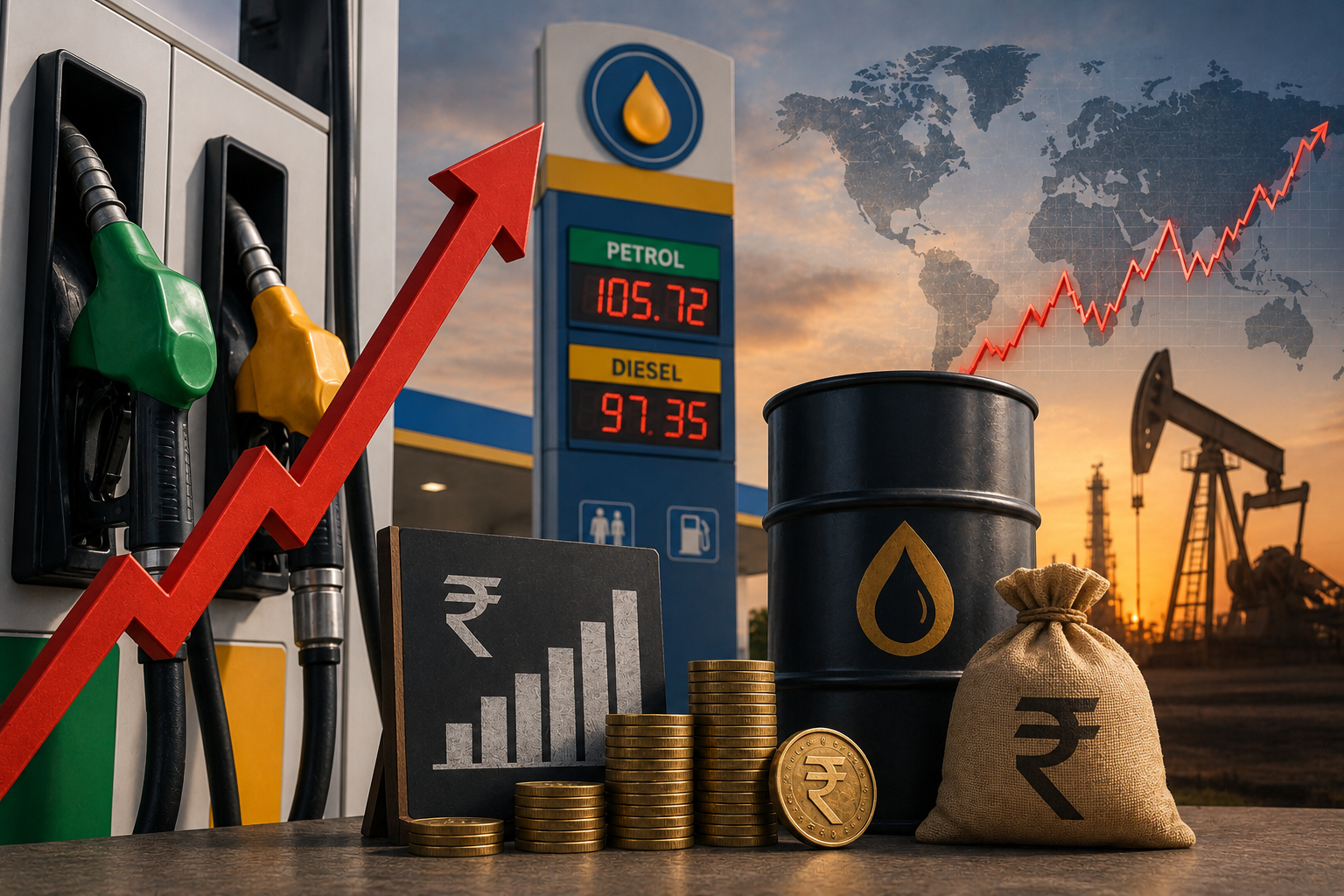
Government Says Daily Under-Recoveries Fall to ₹750 Crore Amid Persistent Crude Oil Shock
The government on Monday said the recent ₹3-per-litre increase in petrol and diesel prices has helped reduce the financial losses of state-run oil markecompanies (OMCs), but officials and economists warned that the relief remains limited as global crude prices continue to stay elevated.
According to the Ministry of Petroleum and Natural Gas, daily under-recoveries of public sector fuel retailers have fallen from nearly ₹1,000 crore to around ₹750 crore following the latest fuel price revision.
However, analysts say the current price increase is still insufficient to fully offset the impact of high crude oil prices, a weakening rupee and disruptions caused by the ongoing West Asia crisis.
The development highlights the growing pressure on India’s energy sector and the difficult policy choices facing the government as geopolitical uncertainty continues to disrupt global oil markets.
Fuel Retailers Continue to Sell Below Cost
Despite the recent hike, petrol and diesel are still being sold below full cost-recovery levels.
According to estimates by ratings agency Crisil:
- Petrol under-recoveries remain around ₹10 per litre
- Diesel under-recoveries remain around ₹13 per litre
Analysts estimate cumulative losses suffered by OMCs since the start of the current geopolitical conflict could cross ₹1 trillion by the end of May if crude prices remain elevated.
The biggest burden continues to fall on state-run fuel retailers, including:
- Indian Oil Corporation (IOC)
- Bharat Petroleum Corporation Ltd (BPCL)
- Hindustan Petroleum Corporation Ltd (HPCL)
High Crude Prices and Weak Rupee Add Pressure
Economists say the recent fuel price increase has slowed financial losses but has not fundamentally solved the problem.
India’s crude import basket has reportedly remained above $106 per barrel, while the Indian rupee has weakened sharply against the US dollar.
This combination is particularly challenging because:
- India imports more than 80 per cent of its crude oil
- A weaker rupee increases import costs further
- Elevated crude prices raise transportation and manufacturing expenses
Experts warn that under current market conditions, fuel economics are changing almost daily.
Some analysts believe retail fuel prices may need to rise by another 10 per cent if OMCs are to see meaningful improvement in profitability without government intervention.
Government Faces Difficult Policy Dilemma
The latest developments have revived a long-standing policy debate over how India should manage fuel pricing during periods of global oil shocks.
The government effectively faces three difficult choices:
- Allow further fuel price hikes
- Provide fiscal support or subsidies
- Let OMCs absorb losses on their balance sheets
Economists believe policymakers are likely to follow a calibrated combination of all three approaches.
However, large-scale subsidies remain politically and fiscally sensitive because India is still managing the long-term impact of past oil-bond programmes used during earlier crude crises.
Analysts say the government is trying to strike a balance between:
- Protecting consumers from sudden price shocks
- Maintaining fiscal discipline
- Preventing excessive losses for OMCs
- Containing inflation
Fuel Pricing Debate Returns to Centre Stage
The crisis has also renewed scrutiny over India’s fuel pricing system.
Although petrol and diesel prices were officially deregulated in:
- 2010 for petrol
- 2014 for diesel
Experts argue that pricing often remains indirectly managed during elections or periods of geopolitical stress.
In practice, OMCs and the government frequently smooth or delay price revisions to avoid sudden spikes at fuel pumps, creating what economists describe as a “semi-administered” pricing regime.
Critics say this hybrid system:
- Distorts market pricing signals
- Creates uncertainty for investors
- Pushes temporary losses onto OMCs
- Delays full cost pass-through to consumers
Inflation Risks Could Increase Further
Economists warn that higher fuel prices may soon spill over into broader inflation across the economy.
Diesel prices, in particular, have major implications because diesel is widely used in:
- Freight transportation
- Agriculture
- Industrial logistics
- Manufacturing supply chains
Higher logistics and transport costs can gradually increase prices of:
- Food products
- Consumer goods
- Industrial materials
- Construction inputs
Analysts estimate the latest fuel hikes could directly add between 0.1 and 0.3 percentage points to consumer inflation, with second-round effects potentially increasing inflation further over time.
Petroleum-linked industrial inputs such as:
- Naphtha
- Bitumen
- Petroleum coke
have already seen rising price pressure in wholesale markets.
India’s History of Managing Oil Shocks
India has historically responded to major crude oil shocks through various policy mechanisms, including:
- Fuel subsidies
- Oil bonds
- Tax cuts
- Upstream burden-sharing
- Controlled retail price increases
During previous crises such as:
- The 1973 Arab oil embargo
- The 1979 Iranian Revolution
- The 1990-91 Gulf War
- The 2008 crude oil supercycle
the government relied heavily on price controls and fiscal support to shield consumers.
However, the current response reflects a gradual shift toward more market-linked pricing and limited fiscal intervention.
What Markets Are Watching Next
The key question now is whether the latest fuel price hikes will be enough if geopolitical tensions continue and crude prices remain elevated for an extended period.
Analysts say investors and policymakers will closely monitor:
- Global crude oil prices
- Rupee movement
- Inflation trends
- OMC financial performance
- Government policy decisions
Some economists argue that allowing fuel prices and the rupee to reflect underlying market realities may ultimately prove more sustainable than suppressing price signals through large subsidies.
At the same time, experts believe targeted welfare support for vulnerable groups may become necessary if inflationary pressures intensify further.
For now, the government appears to be pursuing a middle path — allowing gradual fuel price increases while avoiding direct large-scale bailouts. But with OMCs still losing nearly ₹750 crore daily, analysts caution that the current relief may only buy limited time if the global energy crisis persists.